Your Location:Home > Products > Protein Humanin [14-Glycine] (human)
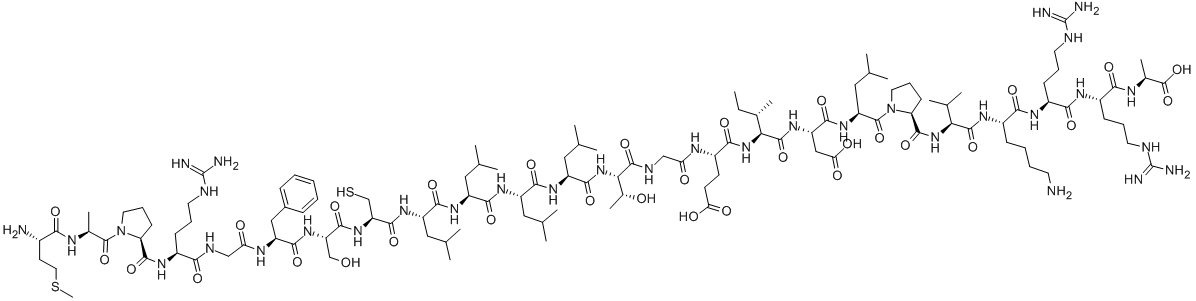
CAS No:330936-70-4
MF:C118H202N34O31S2
Appearance:white or off-white crystalline powder
Specification:98.5%
UN number:-
Package:1/10/100/500g/bottle
Supply Capacity:GRAM
Synonyms:MET-ALA-PRO-ARG-GLY-PHE-SER-CYS-LEU-LEU-LEU-LEU-THR-GLY-GLU-ILE-ASP-LEU-PRO-VAL-LYS-ARG-ARG-ALA;MET-ALA-PRO-ARG-GLY-PHE-SER-CYS-LEU-LEU-LEU-LEU-THR-GLY-GLU-ILE-ASP-LEU-PRO-VAL-LYS-ARG-ARG-ALA TRIFLUOROACETATE;MAPRGFSCLLLLTGEIDLPVKRRA;H-MET-ALA-PRO-ARG-GLY-PHE-SER-CYS-LEU-LEU-LEU-LEU-THR-GLY-GLU-ILE-ASP-LEU-PRO-VAL-LYS-ARG-ARG-ALA-OH;MAPGSGCLLLLTGEIDLPVKRRA;[GLY14]-HN;[GLY14]-HUMANIN;[GLY14] HUMANIN G (HNG), HUMAN; 330936-70-4; (Gly14)-Humanin (human) trifluoroacetate salt; (Gly1?)-Humanin (human); orb1980935; CHEMBL4470851; SCHEMBL29414492; DA-59580; T76508
Product application:Protein Humanin [14-Glycine],HNG peptide,Gly14-Humanin,CAS 330936-70-4,humanin analog,mitochondrial derived peptide,neuroprotective peptide,potent Humanin derivative,anti-apoptotic peptide,Bax inhibitor peptide,Alzheimers disease research,neurotoxicity protection,cardiomyocyte protection,anti-inflammatory peptide,cytoprotective reagent,mitochondrial function enhancer,active pharmaceutical peptide,high purity HNG,custom peptide synthesis,bulk peptide supplier,Suzhou Health Chemicals HNG,research grade Humanin Gly14,Protein Humanin 14-Glycine manufacturer China,buy Gly14 Humanin wholesale,biochemical reagent peptide
Protein Humanin [14-Glycine], commonly designated as HNG, is an engineered, ultra-potent synthetic analog of the endogenous mitochondrial-derived peptide humanin, exhibiting approximately three orders of magnitude higher biological activity and cytoprotective potency than the wild-type sequence. Mechanistically, it acts as a robust survival factor that directly binds to and antagonizes pro-apoptotic Bax protein, effectively preventing Bax translocation to mitochondria, preserving mitochondrial membrane integrity, and inhibiting downstream cytochrome c release and caspase-mediated apoptosis cascades. This peptide is widely utilized in biomedical and translational research for investigating neurodegenerative disorders including Alzheimer disease, amyloid-beta-induced synaptic dysfunction, and prion protein neurotoxicity, while also serving as a crucial molecular tool for dissecting cytoprotection in cerebral and myocardial ischemia-reperfusion models, suppressing inflammatory responses and oxidative stress, and preserving pancreatic beta-cell viability in metabolic disease research.
Address:No. 338, Jingang Avenue, ZhangJiaGang City, Jiangsu Province, China. P.C.:215600Email:sales@healthchems.com
Tel:+86-512-58277800Fax:+86-512-58999904


