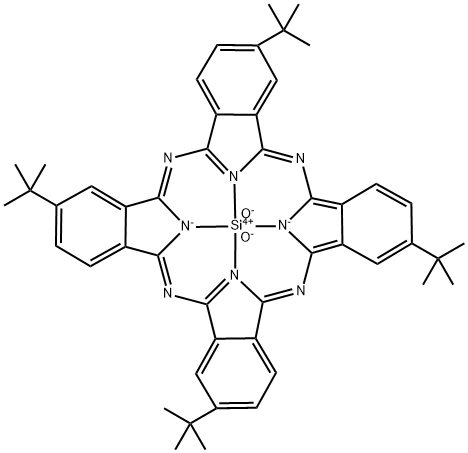
CAS No:85214-70-6
MF:C48H48N8O2Si
Appearance:blue to dark-blue or dark-green crystalline powder
Specification:98.5%
UN number:-
Package:1/10/100/500g/bottle
Supply Capacity:KGS
Synonyms:Silicon 2,9,16,23-tetra-tert-butyl-29H,31H-phthalocyanine dihydroxide Dye content 80 %;Silicon 2,9,16,23-tetra-tert-butyl-29H,31H-phthalocyanine dihydroxide;(OC-6-12)-Dihydroxy[2,9,16,23-tetrakis(1,1-dimethylethyl)-29H,31H-phthalocyaninato(2-)-κN29,κN30,κN31,κN32]silicon;Silicon 2 9 16 23-tetra-tert-butyl-29H; 85214-70-6; Silicon 2,9,16,23-tetra-tert-butyl-29H,31H-phthalocyanine dihydroxide; DTXSID40399066; RefChem:885569; DTXCID40349925; 632-938-7; SILICON 2 9 16 23-TETRA-TERT-BUTYL-29H; 4,13,22,31-tetratert-butyl-38,38-dihydroxy-9,18,27,36,37,39,40,41-octaza-38-siladecacyclo[17.17.3.110,17.128,35.02,7.08,37.011,16.020,25.026,39.029,34]hentetraconta-1(36),2(7),3,5,8,10(41),11(16),12,14,17,19,21,23,25,27,29(34),30,32,35(40)-nonadecaene; SILICON 2 9 16 23-TETRA-TERT-BUTYL-29H;Silicon 2,9,16,23-tetra-tert-butyl-29H,31H-phthalocyanine dihydroxide Dye content 80 %; SCHEMBL19821709; SCHEMBL28099758; Silicon 2,9,16,23-tetra-tert-butyl-29H,31H-phthalocyanine dihydroxide, Dye content 80 %; (9Z,18Z,26Z,35Z)-4,13,22,31-Tetra-tert-butyl-9,18,27,36,37,39,40,41-octaaza-38-siladecacyclo[17.17.3.1~10,17~.1~28,35~.0~2,7~.0~8,37~.0~11,16~.0~20,25~.0~26,39~.0~29,34~]hentetraconta-1,3,5,7,9,11,13,15,17(41),18,20,22,24,26,28(40),29,31,33,35-nonadecaene-38,38-diol
Product application:Dihydroxy[2,9,16,23-tetrakis(1,1-dimethylethyl)-29H,31H-phthalocyaninato(2-)-N29,N30,N31,N32]-Silicon,85214-70-6,Silicon 2,9,16,23-tetra-tert-butyl-29H,31H-phthalocyanine dihydroxide,Tetra-tert-butyl silicon phthalocyanine dihydroxide,Silicon phthalocyanine dihydroxide,Near-infrared absorbing dye,Organic photovoltaic donor acceptor,Perovskite solar cell interlayer,Organic field-effect transistor,Photodynamic therapy photosensitizer,Singlet oxygen photosensitizer,Nonlinear optical material,Laser power limiting dye,Near-infrared fluorescence probe,Optical security ink dye,High purity silicon phthalocyanine 99%,CAS 85214-70-6 supplier,Silicon phthalocyanine manufacturer China,Suzhou Health Chemicals photoelectric materials,Silicon phthalocyanine dihydroxide wholesale bulk export
Dihydroxy[2,9,16,23-tetrakis(1,1-dimethylethyl)-29H,31H-phthalocyaninato(2-)-N29,N30,N31,N32]-Silicon finds widespread and practical utility across organic optoelectronic device fabrication, perovskite solar cell interfacial energy engineering, targeted oncological photodynamic therapy, nonlinear optical laser power limiting protection, near-infrared fluorescence molecular imaging, and high-security anti-counterfeiting ink sectors. In advanced organic photovoltaics and flexible electronic engineering, universally designated across functional materials research as silicon tetra-tert-butylphthalocyanine dihydroxide, its molecular architecture incorporates a central silicon coordination core bracketed by two axial hydroxyl handles and decorated with four bulky peripherally substituted tert-butyl moieties; these steric pendants suppress the co-facial pi-pi molecular self-aggregation common to planar macrocycles, yielding superior processing solubility across toluene, chlorobenzene, and chloroform while retaining intense near-infrared absorption within the red and NIR spectral windows; this broadens light-harvesting capabilities into the deep NIR wavelengths, promoting exciton generation and charge dissociation in thin-film donor-acceptor photovoltaic blends; in hybrid perovskite solar cells, it functions as a functional interfacial passivating layer, where the conjugate aromatic electron cloud coordinates uncoordinated surface lead cations to mitigate interfacial trap density and suppress non-radiative recombination, thereby boosting power conversion efficiency and air-thermal durability; in clinical medicinal photochemistry and cancer nanomedicine, the molecule is deployed as a potent near-infrared photosensitizer characterized by excitation maxima matching deep biological tissue optical penetration windows; encapsulated within targeted lipid nanoparticles or polymeric micelles, it facilitates photoactivation that yields reactive oxygen species, primarily singlet oxygen, inducing selective apoptosis in solid neoplastic lesions and tumor vascular ablation alongside concurrent near-infrared optical imaging for intraoperative tumor boundary visualization; in optical physics and sensor protection, it exhibits pronounced reverse saturable absorption under high-fluence irradiance, transitioning from optical transparency under ambient daylight to optical attenuation during high-energy pulsed laser exposure, making it an essential active dye for solid-state laser protection filters, sensor protection coatings, and optical switching devices; furthermore, in security graphics and security printing, its discrete NIR absorption and fluorescence emissions are leveraged in formulating machine-readable authentication inks, covert security barcodes, and infrared signature control coatings.
Address:No. 338, Jingang Avenue, ZhangJiaGang City, Jiangsu Province, China. P.C.:215600Email:sales@healthchems.com
Tel:+86-512-58277800Fax:+86-512-58999904


