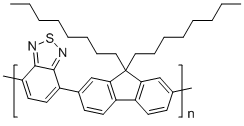
CAS No:210347-52-7
MF:(C35H42N2S)n
Appearance:yellow or orange-yellow solid powder
Specification:98.5%
UN number:-
Package:1/5/10/25kgs/drum
Supply Capacity:KGS
Synonyms:F8BT;Poly[(9,9-di-n-octylfluorenyl-2,7-diyl)-alt-(benzo[2,1,3]thiadiazol-4,8-diyl)];Poly[(9,9-dioctylfluorenyl-2,7-diyl)-alt-(benzo[2,1,3]thiadiazol-4,7-diyl)];gold monochlorid Poly[2,1,3-benzothiadiazole-4,7-diyl(9,9-dioctyl-9H-fluorene-2,7-diyl)];Benzothiadiazole-9,9-dioctylfluorene alternating copolyMer;Benzothiadiazole-9,9-dioctylfluorene copolyMer;PFO-BT;Poly(9,9-dioctylfluorene-alt-benzothiadiazole); F8BT; 210347-52-7; 4-(9,9-dioctylfluoren-2-yl)-2,1,3-benzothiadiazole; thiadiazol-4,7-diyl)]; SCHEMBL4223566; SCHEMBL16019308; C35H44N2S; 2-(2,1,3-Benzothiadiazole-4-yl)-9,9-dioctyl-9H-fluorene; MFCD28975851; Poly[(9,9-di-n-octylfluorenyl-2,7-diyl)-alt-(benzo[2,1,3]thiadia-zol-4,8-diyl)]; SY294585; Poly[(9,9-dioctylfluorenyl-2,7-diyl)-alt-(benzo[2,1,3]; 4-(9,9-Dioctyl-9H-fluoren-2-yl)benzo[c][1,2,5]thiadiazole
Product application:9,9-Dioctylfluorene-2,1,3-benzothiadiazole copolymer,210347-52-7,F8BT,PFBT,Poly[(9,9-dioctylfluorenyl-2,7-diyl)-alt-co-(1,4-benzo-{2,1',3}-thiadiazole)],Fluorene-benzothiadiazole copolymer,Conjugated light-emitting polymer,Yellow-green emitting polymer,PLED emissive material,OLED light-emitting polymer,High PLQY conjugated polymer,Solution-processable semiconducting polymer,Electroluminescent polymer,Fluorescent polymer dots Pdots precursor,Bioimaging fluorescent polymer,Organic solid-state laser gain material,Printed electronics functional ink,High purity F8BT polymer,CAS 210347-52-7 supplier,F8BT manufacturer China,Suzhou Health Chemicals optoelectronic materials,PLED emissive materials wholesale bulk export
9,9-Dioctylfluorene-2,1,3-benzothiadiazole copolymer serves as an indispensable, ultra-pure conjugated donor-acceptor light-emitting copolymer, benchmark solution-processable green-yellow emitting organic semiconductor, and versatile optoelectronic active material extensively utilized across polymer light-emitting diodes (PLEDs), flexible flat-panel displays, ultra-bright fluorescent polymer nanoparticles (Pdots) for bioimaging, organic solid-state lasers, and printed flexible electronics sectors. In organic semiconductor physics and polymer display engineering, universally recognized as F8BT or PFBT, its molecular architecture strategically incorporates alternating electron-rich 9,9-dioctylfluorene donor units and strongly electron-withdrawing 2,1,3-benzothiadiazole acceptor moieties covalently linked along a fully conjugated pi-electron main chain; this alternating donor-acceptor motif induces strong intramolecular charge-transfer (ICT) interactions that narrow the optical bandgap to approximately 2.3-2.4 eV, facilitating balanced electron-hole recombination to yield bright, saturated yellowish-green electroluminescence with solid-state photoluminescence quantum yields exceeding 70 percent; the symmetric installation of flexible aliphatic n-octyl side chains at the C9 bridging position of each fluorene core suppresses deleterious interchain aggregation-induced quenching while imparting robust solubility and fluid rheology in industrial processing solvents including toluene, xylenes, chlorobenzene, and chloroform; this profile ensures processing compatibility with high-throughput deposition methodologies such as high-resolution inkjet printing, slot-die continuous coating, and gravure roll-to-roll manufacturing. In modern analytical biotechnology and fluorescence diagnostics, it functions as the foundational optical core for engineering bright, photostable conjugated polymer dots (Pdots); owing to extraordinarily high absorption cross-sections and rapid intrachain energy harvesting, these Pdots exhibit fluorescence emission intensities orders of magnitude higher than conventional organic fluorophores and colloidal quantum dots, providing non-blinking and non-cytotoxic probes for super-resolution optical nanoscopy, flow cytometry, and targeted cancer cell imaging. In organic solid-state laser technology, its large stimulated emission cross-section supports low-threshold lasing in optical feedback waveguides. Furthermore, in light-emitting electrochemical cells (LECs), antistatic coatings, and specialized optoelectronic monitoring probes for petroleum and natural gas infrastructure, chemical systems engineered from 9,9-Dioctylfluorene-2,1,3-benzothiadiazole copolymer deliver outstanding electroluminescent efficiency, morphological thin-film reproducibility, and broad multi-industry performance.
Address:No. 338, Jingang Avenue, ZhangJiaGang City, Jiangsu Province, China. P.C.:215600Email:sales@healthchems.com
Tel:+86-512-58277800Fax:+86-512-58999904


