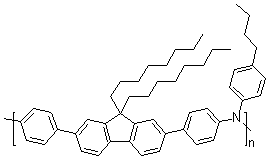
CAS No:223569-31-1
MF:(C51H61N)n
Appearance:light-yellow or yellow solid powder
Specification:98.5%
UN number:-
Package:1/5/10/25kgs/drum
Supply Capacity:KGS
Synonyms:TFB,Poly[(9,9-dioctylfluorenyl-2,7-diyl)-alt-(4,4'-(N-(4-butylphenyl);Poly[(9,9-dioctylfluorenyl-2,7-diyl)-alt-(4,4'-(N-(4-butylphenyl);Poly[(9,9-dioctylfluorenyl-2,7-diyl)-co-(4,4'-(N-(p-butylphenyl))diphenylamine)];Poly[[(4-butylphenyl)imino]-1,4-phenylene(9,9-dioctyl-9H-fluorene-2,7-diyl)-1,4-phenylene];F8-TPA;Poly[(9,9-dioctylfluorenyl-2,7-diyl)-alt-(4,4'-(N-(4-butylphenyl))diphenylamine)];Poly[(9,9-dioctylfluorenyl-2,7-diyl)-co-(4,4′-(N-(p-butylphenyl))diphenylamine)];TFB, Poly[(9,9-dioctylfluorenyl-2,7-diyl)-alt-(4,4'-(N-(4- butylphenyl)diphenylamine)]; GALLIUM; 7440-55-3; CH46OC8YV4; DTXSID401029758; CHEBI:49631; Gallium Metallicum; RefChem:55245; 231-163-8; DTXCID5047661; Ga; gallium atom; galio; Gallium ingot; Gallium metal; MFCD00134045; 223569-31-1; Gallium pellets, 6mm dia; GALLIUM69; Gallium, elemental; Gallium(1+); Gallium metal, packaged in poylethylene bottle; HSDB 6956; Gallium, ion (Ga1+); EINECS 231-163-8; UN2803; UNII-CH46OC8YV4; Atomic Gallium; Element Gallium; Element:Gallium; Gallium Standard: Ga @ 1000 microg/mL in 5% HNO3, 0.5% HCl; Gallium Standard: Ga @ 10000 microg/mL in 5% HNO3, 0.5% HCl; Element-Ga; Element:Ga; Gallium (atomic); GYHNNYVSQQEPJS-UHFFFAOYSA-N; Ga (element); Gallium (element); GALLIUM ELEMENT; GALLIUM [HSDB]; GALLIUM [MI]; GALLIUM, ELEMENTSL; SCHEMBL29351616; SCHEMBL29444715; SCHEMBL29651334; Gallium [UN2803] [Corrosive]; AKOS015902738; Gallium, 99.99% trace metals basis; Gallium, 99.999% trace metals basis; Gallium, 99.9995% trace metals basis; Q861; AA standard GALLIUM 1M HCL 1000 ppm; AA standard GALLIUM 1M HCL 10000 ppm; NS00076440; Gallium metal, 99.9995% trace metals grade; Isotopic standard for gallium, NIST SRM 994; Gallium, pieces, 99.99999% trace metals basis; ICP standard Gallium 2-5% HNO3 1000 microg/mL; Gallium - Ga @ 1000 microg/mL in 5% HNO3, 0.5% HCl; Poly[(9,9-dioctylfluorenyl-2,7-diyl)-alt-(4,4 inverted exclamation marka-(N-(4-butylphenyl); Poly[(9,9-dioctylfluorenyl-2,7-diyl)-alt-(4,4'-(N-(4-butylphenyl), Mw 10,000-100,000 by GPC
Product application:Poly[(9,9-dioctylfluorenyl-2,7-diyl)-co-(4,4'-(N-(p-butylphenyl))diphenylamine)],223569-31-1,TFB,Poly[(9,9-dioctylfluorenyl-2,7-diyl)-alt-(4,4'-(N-(4-butylphenyl)aniline))],Fluorene-arylamine copolymer,Hole transport polymer,HTL polymer,Hole injection material,QLED hole transport layer,OLED hole transporting material,Quantum dot LED materials,Printed electronics hole conductor,Inverted perovskite solar cell HTL,Blue light emitting polymer,High hole mobility polymer,Solution-processable semiconducting polymer,Organic semiconductor polymer,Inkjet printing functional polymer,High purity TFB polymer,CAS 223569-31-1 supplier,TFB manufacturer China,Suzhou Health Chemicals optoelectronic materials,HTL materials wholesale bulk export
Poly[(9,9-dioctylfluorenyl-2,7-diyl)-co-(4,4'-(N-(p-butylphenyl))diphenylamine)] serves as an indispensable, ultra-pure conjugated hole-transporting polymer, benchmark solution-processable organic semiconductor, and versatile interfacial electronic modifier extensively utilized across quantum-dot light-emitting diodes (QLEDs), organic light-emitting diodes (OLEDs), inverted perovskite solar cells (PSCs), broadband photodetectors, and printed electronics sectors. In organic semiconductor physics and advanced flat-panel display manufacturing, universally designated as TFB, its molecular architecture incorporates alternating electron-rich triarylamine units and rigid 9,9-dioctylfluorene moieties covalently linked along a conjugated pi-electron main chain; it exhibits an optimal highest occupied molecular orbital (HOMO) energy level aligned between -5.30 eV and -5.40 eV, which establishes a barrier-free cascading energetic bridge from standard transparent anode contacts like ITO/PEDOT:PSS into active light-emitting layers composed of colloidal quantum dots or emissive polymers; concurrently, its elevated lowest unoccupied molecular orbital (LUMO) energy level functions as an efficient electron-blocking barrier, trapping excess electrons within the recombining emissive zone to balance charge transport and elevate electroluminescent exciton formation efficiency while eliminating unwanted parasitic current leakage. Optoelectronically, the presence of flexible aliphatic octyl and butyl side chains confers excellent solubility in aromatic solvents such as toluene, xylenes, and chlorobenzene, ensuring rheological compatibility with high-throughput solution deposition processes including high-precision inkjet printing, slot-die coating, and continuous roll-to-roll manufacturing; following thermal annealing, it forms ultra-smooth, pinhole-free, and robust amorphous films with solvent orthogonality that protects the underlying layer from dissolution during upper-layer processing. In inverted (p-i-n) planar perovskite photovoltaics, it is deployed as an efficient hole-extraction and interface-passivation interlayer; its uniform hydrophobic surface guides the crystallization of dense, large-grain perovskite absorber layers while passivating undercoordinated interfacial defect sites to suppress trap-assisted non-radiative charge recombination, significantly enhancing power conversion efficiency (PCE) alongside operational photothermal endurance. In organic field-effect transistors and photodetector arrays, it suppresses dark currents to maximize frequency response and signal-to-noise ratios. Furthermore, in antistatic conductive polymer matrices, functional charge-injection coatings, and specialized optoelectronic monitoring probes for petroleum and natural gas infrastructure, chemical systems engineered from Poly[(9,9-dioctylfluorenyl-2,7-diyl)-co-(4,4'-(N-(p-butylphenyl))diphenylamine)] deliver extraordinary hole mobility, environmental thin-film stability, and broad multi-industry performance.
Address:No. 338, Jingang Avenue, ZhangJiaGang City, Jiangsu Province, China. P.C.:215600Email:sales@healthchems.com
Tel:+86-512-58277800Fax:+86-512-58999904


