Your Location:Home > Products > 4-Vinylbenzylphosphonic acid
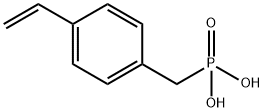
CAS No:53459-43-1
MF:C9H11O3P
Appearance:white or off-white fine powder
Specification:98.5%
UN number:-
Package:1/10/25kg/drum
Supply Capacity:Tons
Synonyms:Phosphonic acid, [(4-ethenylphenyl)methyl]-;4-VINYLBENZYLPHOSPHONIC ACID;P-[(4-Ethenylphenyl)methyl]phosphonic acid;Phosphonic acid, P-[(4-ethenylphenyl)methyl]-;(4-ethenylphenyl)methylphosphonicacid;p-[(4-vinylphenyl)methyl]phosphonic acid,"Phosphonic acid, [(4-ethenylphenyl)methyl]-","53459-43-1; Phosphonic acid, [(4-ethenylphenyl)methyl]-; MFCD21596681; 4-vinylbenzylphosphonic acid; (4-ethenylphenyl)methylphosphonic Acid; SCHEMBL633379; (4-Vinylbenzyl)phosphonic acid; DTXSID30464712; (4-vinylphenyl)methylphosphonic acid; AKOS015945895",198.160,C9H11O3P,
Product application:P-[(4-ethenylphenyl)methyl]phosphonic Acid, 4-vinylbenzylphosphonic acid, VBP, CAS 53459-43-1, phosphonic acid monomer, functionalized styrene, adhesion promoter, flame retardant monomer, metal surface treatment chemical, proton conduct polymer, dental adhesive monomer, polymerizable phosphonate, corrosion inhibitor, coupling agent, high purity phosphonic acid, reactive monomer for fuel cells.
Applications:
P-[(4-Ethenylphenyl)methyl]phosphonic acid, also known as 4-Vinylbenzylphosphonic acid with CAS number 53459-43-1, is a highly versatile bifunctional monomer that combines a reactive vinyl group with a terminal phosphonic acid moiety, making it an essential building block for advanced materials science. In terms of detailed efficacy, this compound excels as a molecular linker that imparts exceptional adhesive properties, superior flame retardancy, and robust chemical stability to various polymer systems through precise polymerization processes, while its acidic functional group provides strong coordination capabilities with metal ions and inorganic surfaces. Regarding specific applications, it is extensively utilized in the biomedical sector for the formulation of high-performance dental adhesives and orthopedic cements; it is equally critical in the energy sector for fabricating proton-conducting membranes in fuel cells. Furthermore, this monomer is a key component in the synthesis of functionalized resins for selective metal ion recovery and serves as a sophisticated surface modifier in the electronics industry to enhance corrosion resistance and interlayer bonding.
Address:No. 338, Jingang Avenue, ZhangJiaGang City, Jiangsu Province, China. P.C.:215600Email:sales@healthchems.com
Tel:+86-512-58277800Fax:+86-512-58999904


