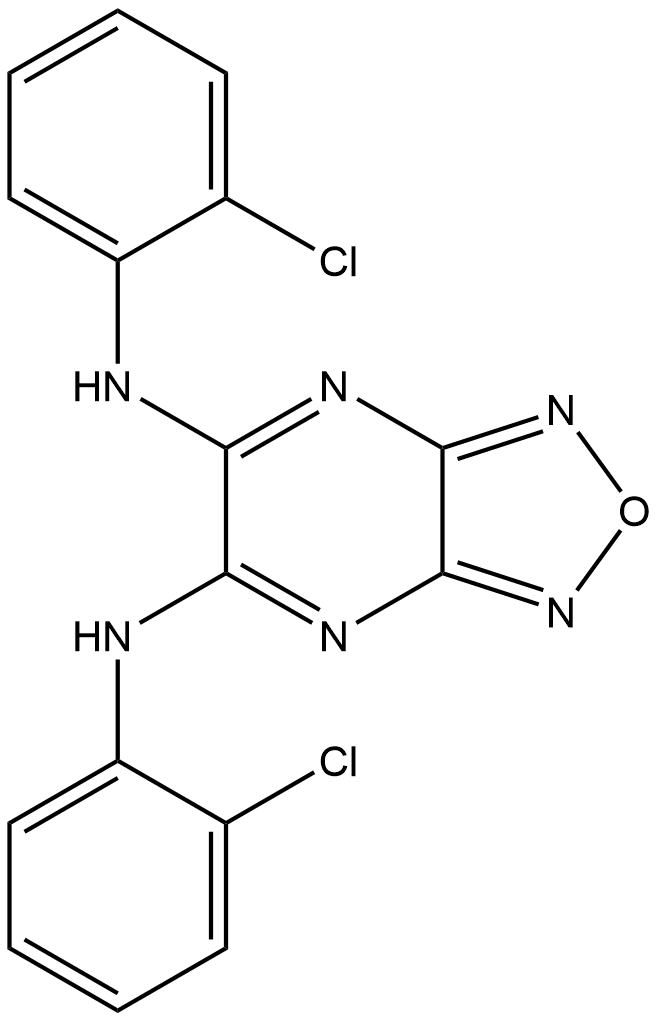
CAS No:210302-02-6
MF:C16H10Cl2N6O
Appearance:off-white or light-yellow crystalline powde
Specification:98.5%
UN number:-
Package:1/5/10/25kgs/drum
Supply Capacity:KGS
Synonyms:[1,2,5]Oxadiazolo[3,4-b]pyrazine-5,6-diamine, N5,N6-bis(2-chlorophenyl)-;BAM15A;BAMA15; BAM15A; Oprea1_420362; Oprea1_580163; CHEMBL5176280; SCHEMBL17249529; EX-A17119; AKOS000678704; ST50301172; SR-01000325861; SR-01000325861-1; (2-chlorophenyl){6-[(2-chlorophenyl)amino](1,2,5-oxadiazolo[3,4-e]pyrazin-5-yl )}amine; 210302-02-6
Product application:N5,N6-Bis(2-Chlorophenyl)-[1,2,5]oxadiazolo[3,4-b]pyrazine-5,6-diamine,210302-02-6,BAM15A,BAM-15A,BAM 15A,[1,2,5]Oxadiazolo[3,4-b]pyrazine-5,6-diamine, N5,N6-bis(2-chlorophenyl)-,Mitochondrial protonophore uncoupler,Mitochondrial uncoupling agent,Energy expenditure promoter,Anti-obesity research chemical,Fatty liver disease active agent,NASH drug discovery tool,Insulin sensitizing compound,Heterocyclic building block,Biochemical research reagent,High purity BAM15A 99.5%,CAS 210302-02-6 supplier,BAM15A manufacturer China,Suzhou Health Chemicals specialty chemicals,BAM-15A powder wholesale bulk export
N5,N6-Bis(2-Chlorophenyl)-[1,2,5]oxadiazolo[3,4-b]pyrazine-5,6-diamine serves as an indispensable, ultra-pure heterocyclic chemical entity, benchmark mitochondrial protonophore uncoupler research tool, and versatile bioenergetic probe extensively utilized across targeted metabolic disease drug discovery, anti-obesity and type 2 diabetes lead optimization, nonalcoholic steatohepatitis therapeutic screening, and tissue ischemia-reperfusion injury exploration sectors. In metabolic pharmacology and cellular physiology research, commonly recognized across biomedical scientific investigations as BAM15A or an active BAM-15 congener, its molecular architecture incorporates an electron-deficient [1,2,5]oxadiazolo[3,4-b]pyrazine fused aromatic core flanked by symmetric 2-chloroanilino amine pendants; this planar, highly conjugated polyaza framework combines lipophilicity with delocalized proton-transfer capabilities, enabling it to function as a protonophore that transports protons across the mitochondrial inner membrane into the matrix; this action dissipates the transmembrane proton gradient, decoupling nutrient oxidation from adenosine triphosphate (ATP) synthesis to stimulate mitochondrial respiration and fatty acid catabolism; unlike legacy chemical uncouplers such as 2,4-dinitrophenol (DNP) or FCCP, this compound exhibits a wide therapeutic safety window and membrane-potential-limited uncoupling characteristics, reducing adiposity and enhancing insulin sensitivity without causing hyperthermia, acute off-target plasma membrane depolarization, or cellular cytotoxicity; in experimental hepatology, it is deployed as an active probe in models of metabolic dysfunction-associated steatohepatitis (MASH), evaluating molecular cascades that clear intracellular lipid droplets, attenuate reactive oxygen species generation, and inhibit fibrogenic transformation; in cardiovascular and organ-preservation studies, it is investigated for its potential to blunt oxidative reperfusion injury and preserve mitochondrial integrity during acute ischemic stress. Furthermore, in functional optoelectronic heterocyclic polymers, nitrogen-dense conjugated coordination networks, and specialized molecular probes, chemical architectures engineered from N5,N6-Bis(2-Chlorophenyl)-[1,2,5]oxadiazolo[3,4-b]pyrazine-5,6-diamine deliver exceptional structural rigidity, reproducible protonophore kinetics, and broad multi-industry value.
Address:No. 338, Jingang Avenue, ZhangJiaGang City, Jiangsu Province, China. P.C.:215600Email:sales@healthchems.com
Tel:+86-512-58277800Fax:+86-512-58999904


