Your Location:Home > Products > 2-Thiouracil
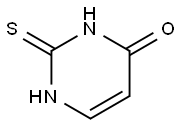
CAS No:141-90-2
MF:C4H4N2OS
Appearance:white or off-white crystalline powder
Specification:98.5%
UN number:-
Package:1/5/10/25kgs/drum
Supply Capacity:MT
Synonyms:2-Thiouracil Vetec(TM) reagent grade, 99%;2-ThiouraCll;4-HYDROXY-2-MERCAPTOPYRIMIDINE;4-HYDROXY-2-THIOPYRIMIDINE;2-MERCAPTO-4-PYRIMIDONE;2-MERCAPTO-4-HYDROXYPYRIMIDINE;2-thio-uraci;2-TU; 2-thiouracil; Thiouracil; 141-90-2; Deracil; Antagothyroid; Antagothyroil; Nobilen; 2-thioxo-2,3-dihydropyrimidin-4(1H)-one; 2-Mercapto-4-hydroxypyrimidine; 2-Mercapto-4-pyrimidone; 4(1H)-Pyrimidinone, 2,3-dihydro-2-thioxo-; 6-Thiouracil; 2-Mercapto-4-pyrimidinol; Uracil, 2-thio-; 2-sulfanylidene-1H-pyrimidin-4-one; 4-Hydroxy-2-pyrimidinethiol; 2,3-Dihydro-2-thioxo-4(1H)-pyrimidinone; 6-Hydroxy-2-mercaptopyrimidine; 2-Thio-1,3-pyrimidin-4-one; 2-Mercapto-4(1H)-pyrimidinone; 4-Hydroxy-2(1H)-pyrimidinethione; 2-Thio-4-oxypyrimidine; DTXSID4021347; 2-Thio-2,4-(1H,3H)-pyrimidinedione; 59X161SCYL; 2-Thio-4-oxo-1,3-pyrimidine; NCI-C01490; NSC-19473; CHEBI:348530; DTXCID701347; NSC19473; RefChem:389318; 205-508-8; 2-Mercaptopyrimidin-4-ol; 4-Hydroxy-2-mercaptopyrimidine; 80275-68-9; 4-Pyrimidinol, 2-mercapto-; 2-sulfanylpyrimidin-4-ol; 2-TU; MFCD00006039; Tiouracyl; 125220-28-2; 4-hydroxypyrimidine-2(1H)-thione; 4(3H)-Pyrimidinone, 2-mercapto- (9CI); 126160-72-3; 156-82-1; EINECS 205-508-8; Uracil, 2-thio- (VAN); NSC 19473; TU; 2(1H)-Pyrimidinethione, 6-hydroxy- (9CI); 2-Mercaptopyrimid-4-one; 124700-71-6; 124700-72-7; 2-mercaptopyrimidine-4-one; 2-Mercapto-pyrimidin-4-ol; BSPBio_002617; 2-Thioxo-2,3-dihydro-1H-pyrimidin-4-one; 2-thioxo-2,3-dihydro-4(1h)-pyrimidinone; HMS500F06; Tox21_202418; MFCD00044203; Tox21_111418_1; NCGC00095088-01; Tiouracyl [Polish]; 2-Thiouracil (VAN); 2-Thio-6-oxypyrimidine; CAS-141-90-2; CCRIS 587; HSDB 2954; 4(1H)-Pyrimidinone, 2-mercapto- (9CI); 2(1H)-Pyrimidinethione, 4-hydroxy- (9CI); UNII-59X161SCYL; 2-thioxo-1H-pyrimidin-4-one; 2,3-dihydro-2-thioxopyrimidin-4(1h)-one; AI3-25474; 2-sulfanylpyrimidin-4(3H)-one; 4(3H)-Pyrimidinone, 2-mercapto-; 2-sulfanylidene-1,2,3,4-tetrahydropyrimidin-4-one; 4-Pyrimidinol, 2-mercapto- (9CI); 2-thio-4-pyrimidone; Spectrum_001652; SpecPlus_000746; 4-hydroxypyrimidinethione; Spectrum3_000979; Spectrum4_001104; Spectrum5_001378; THIOURACIL [HSDB]; THIOURACIL [IARC]; WLN: T6MYMVJ BUS; 2-Mercapto-4-hydroxypyrim; 2-Thiouracil, >=99%; SCHEMBL9172; 2-THIOURACIL [MI]; THIOURACIL [WHO-DD]; 2-Sulfanyl-4-pyrimidinol #; 6-hydroxypyrimidine-2-thione; KBioGR_001548; KBioSS_002132; DivK1c_000104; DivK1c_006842; SCHEMBL191107; SCHEMBL536791; SCHEMBL536824; SCHEMBL545998; SCHEMBL546068; SPECTRUM1503973; CHEMBL345768; orb1226324; orb1309025; orb3139196; SCHEMBL2856254; SCHEMBL3575471; SCHEMBL6055206; SCHEMBL6987177; 2-sulfanyl-1H-pyrimidin-6-one; SCHEMBL11359888; SCHEMBL11423232; SCHEMBL29948586; KBio1_000104; KBio1_001786; KBio2_002132; KBio2_004700; KBio2_007268; KBio3_001837; MSK7112; HMS1922O08; HMS3651F22; HMS3885A09; HMS5081M14; Pharmakon1600-01503973; pyrimidine, 4-hydroxy-2-mercapto-; HY-B0503; Tox21_111418; Tox21_302955; AB7033; BDBM50608607; CCG-39926; EBC-06143; EBC-49024; NSC758660; s3100; SBB007592; STL011919; STL134904; STL168055; STL185506; AKOS000119226; AKOS002303247; AKOS005366847; AKOS022061520; CCG-266107; FT02604; GS-6727; NSC-758660; SB57767; 2-sulfanyl-1,4-dihydropyrimidin-4-one; 2-sulfanyl-3,4-dihydropyrimidin-4-one; IDI1_000104; SMP1_000293; NCGC00095088-02; NCGC00095088-03; NCGC00095088-04; NCGC00095088-05; NCGC00095088-07; NCGC00249223-01; NCGC00256423-01; NCGC00259967-01; ST075010; SY014748; 4(1H)-PYRIMIDINONE, 2-MERCAPTO-; SBI-0051878.P002; DB-004877; DB-028206; DB-268876; DB-268885; DB-272086; DB-272204; 2(1H)-PYRIMIDINETHIONE, 4-HYDROXY-; 2(1H)-PYRIMIDINETHIONE, 6-HYDROXY-; CS-0369245; NS00008703; SW220234-1; 2-Thiouracil, Vetec(TM) reagent grade, 99%; EN300-16770; C19304; pyrimidin-4(1H)-one, 2,3-dihydro-2-thioxo-; T-3800; 2-Sulfanylidene-2,3-dihydropyrimidin-4(1H)-one; AB00052397_02; AB00171996_02; 2-Thiouracil, VETRANAL(TM), analytical standard; AG-670/31547014; F078506; SR-01000872748; SR-01000872748-1; BRD-K58819470-001-04-2; BRD-K58819470-001-05-9; Q20892027; Z56771015; F0001-0490; InChI=1/C4H4N2OS/c7-3-1-2-5-4(8)6-3/h1-2H,(H2,5,6,7,8; TUL
Product application:2-Thiouracil,141-90-2,4-Hydroxy-2-mercaptopyrimidine,2-Mercapto-4-hydroxypyrimidine,2-Thio-2 4-pyrimidinedione,Sulfur-containing pyrimidine base,Pharmaceutical grade 2-Thiouracil,Antithyroid API intermediate,Propylthiouracil synthesis raw material,Methylthiouracil precursor,Hyperthyroidism therapeutic intermediate,Antiviral drug building block,Antineoplastic intermediate,Melanoma targeting probe precursor,Melanin biosynthesis tracer,Thyroid peroxidase inhibitor,Thionucleoside synthesis building block,Modified RNA monomer,Agrochemical intermediate,Pyrimidinetype fungicide raw material,Research biochemical CAS 141-90-2,High purity 2-Thiouracil 99%,2-Thiouracil manufacturer China,CAS 141-90-2 supplier,Suzhou Health Chemicals pyrimidines,2-Thiouracil wholesale bulk export
2-Thiouracil serves as an indispensable sulfur-containing pyrimidine base, fundamental heterocyclic building block, and versatile metabolic active agent extensively utilized across endocrine pharmacology, targeted oncology diagnostics, nucleic acid modification chemistry, and fine agrochemical development. In commercial active pharmaceutical ingredient (API) manufacturing and endocrine therapeutics, functioning as a primary thioureylene pharmacophore, it is the pivotal structural precursor for the industrial synthesis of classic antithyroid agents, notably Propylthiouracil and Methylthiouracil; by selectively inhibiting the catalytic activity of thyroid peroxidase (TPO), it effectively impedes the iodination of tyrosine residues on thyroglobulin and blocks iodotyrosine coupling, thereby suppressing the biosynthesis of triiodothyronine (T3) and thyroxine (T4) for managing hyperthyroidism, Graves disease, and thyrotoxic crisis. In nuclear medicine and translational oncology, owing to its distinct metabolic incorporation into active melanogenesis pathways during melanin polymer formation, 2-Thiouracil is widely utilized as a core radiopharmaceutical precursor to develop radiolabeled molecular imaging probes for high-contrast detection and targeted radionuclide therapy of disseminated malignant melanoma lesions. In nucleic acid chemical biology and epitranscriptomics research, it is an essential monomer for synthesizing 2-thiouridine (s2U) and related modified ribonucleosides naturally present in transfer RNA (tRNA) anticodon loops to investigate translational fidelity, codon-anticodon recognition mechanisms, and photoactivatable RNA-protein crosslinking kinetics. Furthermore, in agricultural crop protection and chemical engineering, 2-Thiouracil functions as a reactive heterocyclic intermediate for synthesizing selective plant growth regulators, heterocyclic fungicides, and industrial corrosion inhibition formulations.
Address:No. 338, Jingang Avenue, ZhangJiaGang City, Jiangsu Province, China. P.C.:215600Email:sales@healthchems.com
Tel:+86-512-58277800Fax:+86-512-58999904


