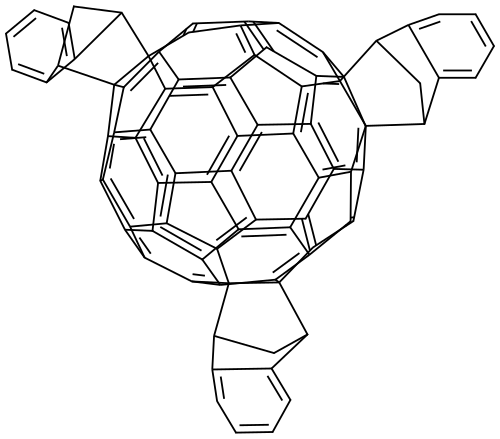
CAS No:1363385-54-9
MF:C87H24
Appearance:dark-brown or black-brown crystalline powder
Specification:99.0%
UN number:-
Package:1/5/10/25kgs/drum
Supply Capacity:KGS
Synonyms:2'',3'':23,42;2''',3''':32,50][5,6]fullerene-C60-Ih, 1',1'',1''',4',4'',4'''-hexahydro-;Tri[1,4]methanonaphtho[2',3':1,2; fullerene-C60-Ih; 1',1'',1''',4',4'',4'''-Hexahydrotri[1,4]; methanonaphtho[2',3':1,2;2'',3'':23,42;2''',3''':32,50][5,6]; 1363385-54-9
Product application:Indene-C60 triadduct,1363385-54-9,IC60TA,ICTA,Tris-indene-C60 adduct,Fullerene C60 triadduct,Electron acceptor material,High open circuit voltage acceptor,Ultra-high LUMO level acceptor,Organic photovoltaic acceptor,Polymer solar cell material,Ternary OPV active layer material,Perovskite solar cell electron transport material,Inverted perovskite passivator,n-type organic semiconductor,Broadband optoelectronic material,Organic photodetector material,Organic field-effect transistor material,Electronic grade fullerene derivative,High purity IC60TA 99.5%,1363385-54-9 supplier,IC60TA manufacturer China,Suzhou Health Chemicals optoelectronic materials,IC60TA wholesale bulk export
Indene-C60 triadduct serves as an indispensable, ultra-pure multi-adduct fullerene derivative, benchmark n-type organic semiconductor electron acceptor with an exceptionally high LUMO level, and versatile optoelectronic interfacial modifier extensively utilized across high open-circuit voltage polymer organic photovoltaics (OPV), inverted perovskite solar cells (PSCs), broadband organic photodetectors, organic thin-film transistors (OTFTs), and flexible printed electronics sectors. In organic semiconductor physics and advanced photovoltaic device engineering, universally designated as IC60TA or ICTA, its molecular architecture incorporates three rigid indene moieties covalently grafted via Diels-Alder cycloadditions onto a single spherical C60 fullerene cage; this high-degree addition strategically disrupts the extended conjugated pi-system of the fullerene core, driving its lowest unoccupied molecular orbital (LUMO) energy level up to approximately -3.60 eV, which is more than 0.30 eV higher than standard PC61BM and distinctly above bis-adduct analogues; when blended with wide-bandgap conjugated donor polymers such as P3HT within bulk-heterojunction (BHJ) active layers, this elevated LUMO level dramatically widens the effective interfacial energy bandgap between the donor HOMO and acceptor LUMO, propelling the open-circuit voltage (Voc) toward and beyond 1.0 V; furthermore, the installation of three bulky indene groups effectively suppresses excessive self-aggregation of the fullerene spheres, imparting superior solubility in industrial processing solvents such as chlorobenzene, o-dichlorobenzene, and toluene, thereby facilitating fine-tuned nanoscale interpenetrating bicontinuous networks that ensure efficient charge generation with minimal bimolecular recombination. In inverted (p-i-n) planar heterojunction perovskite solar cells, it functions as an advanced electron-extraction and defect-passivating interlayer; its elevated LUMO level establishes a barrier-free energetic alignment with the perovskite conduction band, minimizing interfacial energy loss during electron transport, while its spatial polycyclic architecture coordinatively passivates uncoordinated surface metal defect sites and halide vacancies along grain boundaries, effectively suppressing non-radiative recombination losses and enhancing device photothermal durability under prolonged continuous operation. In broadband organic photodiodes and optical sensors, it suppresses leakage currents to maximize detectivity and signal-to-noise performance. Furthermore, in organic field-effect transistors, functional antistatic polymer composites, and specialized optoelectronic monitoring probes for petroleum and natural gas infrastructure, chemical systems engineered from Indene-C60 triadduct deliver outstanding electronic tunability, reproducible thin-film reliability, and broad multi-industry value.
Address:No. 338, Jingang Avenue, ZhangJiaGang City, Jiangsu Province, China. P.C.:215600Email:sales@healthchems.com
Tel:+86-512-58277800Fax:+86-512-58999904


