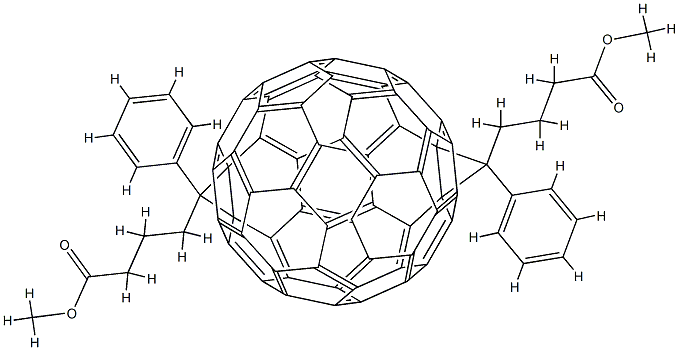
CAS No:1048679-01-1
MF:C84H28O4
Appearance:dark-brown or black-brown crystalline powder
Specification:99.0%
UN number:-
Package:1/5/10/25kgs/drum
Supply Capacity:KGS
Synonyms:3',3''-Diphenyl-3'H,3''H-dicyclopropa[1,9:52,60][5,6]fullerene-C60-Ih-3',3''-dibutanoic acid 3',3''-dimethyl ester;Bis-PCBM (mixture of isomers);BIS-PC60BM;Bis-PCBM(mixtureofisomers)>3'H,3''H-Dicyclopropa[1,9:52,60][5,6]fullerene-C60-Ih-3',3''-dibutanoic acid, 3',3''-diphenyl-, 3',3''-dimethyl ester;bis-PCBM (PC60BM Bisadduct);Bis-PCBM; 1048679-01-1; Bis-PCBM; 3',3''-Diphenyl-3'H,3''H-dicyclopropa[1,9:52,60][5,6]fullerene-C60-Ih-3',3''-dibutanoic acid 3',3''-dimethyl ester; 3',3''-Diphenyl-3'H,3''H-dicyclopropa[1,9; Bis[60]PCBM (mixture of isomers); MFCD11656091; Bis-PC60BM; SCHEMBL29360559; C84H28O4; SY117094; B4576; Bis-PCBM (mixture of isomers), 88.00-95.00 %; [6.6] Diphenyl C62 bis(butyric acid methyl ester)(mixture of isomers); Bis(1-[3-(methoxycarbonyl)propyl]-1-phenyl)-[6.6]C62 (mixture of isomers),BisPCBM
Product application:3',3''-Diphenyl-3'H,3''H-dicyclopropa[1,9:52,60][5,6]fullerene-C60-Ih-3',3''-dibutanoic acid 3',3''-dimethyl ester,1048679-01-1,Bis-PCBM,Bis-PC61BM,Bis-[60]PCBM,Di-[60]PCBM,Bis-phenyl-C61-butyric acid methyl ester,Fullerene C60 bisadduct,High LUMO electron acceptor,High Voc acceptor material,Organic photovoltaic electron acceptor,Polymer solar cell active layer material,Ternary OPV additive,Perovskite solar cell electron transport material,Inverted perovskite passivator,n-type organic semiconductor,Organic photodetector material,Organic field-effect transistor material,Electronic grade fullerene derivative,High purity Bis-PCBM 99.5%,CAS 1048679-01-1 supplier,Bis-PCBM manufacturer China,Suzhou Health Chemicals optoelectronic materials,Bis-PC61BM wholesale bulk export
3',3''-Diphenyl-3'H,3''H-dicyclopropa[1,9:52,60][5,6]fullerene-C60-Ih-3',3''-dibutanoic acid 3',3''-dimethyl ester serves as an indispensable, ultra-pure functionalized fullerene bisadduct derivative, benchmark n-type organic semiconductor electron acceptor with elevated LUMO levels, and versatile interfacial passivation material extensively utilized across polymer organic photovoltaics (OPV), inverted perovskite solar cells (PSCs), broadband organic photodetectors, organic thin-film transistors (OTFTs), and flexible printed electronics sectors. In organic semiconductor physics and advanced photovoltaic device engineering, universally recognized as Bis-PC61BM, Bis-PCBM, or Bis-[60]PCBM, its molecular architecture incorporates two solubilizing phenyl-butyric acid methyl ester cyclopropane moieties covalently grafted onto a single spherical C60 fullerene core; this dual functionalization moderately contracts the extended pi-conjugated network of the fullerene cage, driving its lowest unoccupied molecular orbital (LUMO) energy level up by approximately 0.15 eV relative to the benchmark mono-adduct PC61BM; when blended with conjugated donor polymers such as P3HT within bulk-heterojunction (BHJ) active layers, this elevated LUMO level substantially expands the electrochemical bandgap between donor HOMO and acceptor LUMO, propelling the open-circuit voltage (Voc) from 0.6 V to beyond 0.73-0.75 V, thereby delivering a notable surge in device power conversion efficiency (PCE); furthermore, the two pendant aliphatic ester chains disrupt self-crystallization tendencies, conferring superior thermodynamic solubility and solution processability in aromatic solvents such as chlorobenzene, o-dichlorobenzene, and toluene, which effectively suppresses macroscopic domain agglomeration to establish ideal nanoscale interpenetrating bicontinuous networks that ensure efficient sub-picosecond charge generation with minimal bimolecular recombination. In inverted (p-i-n) planar heterojunction perovskite solar cells, it is deployed as an electron-transporting and defect-passivating layer; its tailored LUMO level establishes a barrier-free energetic cascading alignment with the perovskite conduction band, minimizing interfacial energy dissipation, while its multivalent polar ester handles and pi-electron clouds coordinatively interact with undercoordinated surface lead ions and halide vacancies across perovskite grain boundaries, effectively quenching non-radiative trap states, reducing hysteresis, and enhancing long-term operational photothermal durability. In broad-spectrum organic photodiodes and optical sensors, it suppresses leakage currents to maximize detectivity and signal-to-noise performance. Furthermore, in organic field-effect transistors, functional antistatic polymer composites, and specialized optoelectronic monitoring probes for petroleum and natural gas infrastructure, chemical systems engineered from 3',3''-Diphenyl-3'H,3''H-dicyclopropa[1,9:52,60][5,6]fullerene-C60-Ih-3',3''-dibutanoic acid 3',3''-dimethyl ester deliver outstanding electronic tunability, reproducible thin-film reliability, and broad multi-industry value.
Address:No. 338, Jingang Avenue, ZhangJiaGang City, Jiangsu Province, China. P.C.:215600Email:sales@healthchems.com
Tel:+86-512-58277800Fax:+86-512-58999904


