Your Location:Home > Products > 1',4'-Dihydro-naphtho[2', 3':1, 2][5, 6]fullerene-C60
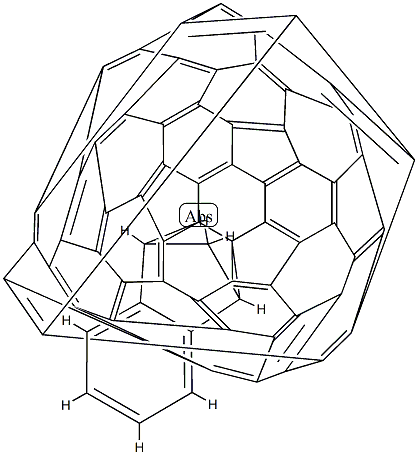
CAS No:186682-36-0
MF:C69H8
Appearance:dark-brown or black-brown crystalline powder
Specification:99.0%
UN number:-
Package:1/5/10/25kgs/drum
Supply Capacity:KGS
Synonyms:ICMA 97% (HPLC);C60 DERIVATIVES;[1,4]Methanonaphtho[2',3':1,9][5,6]fullerene-C60-Ih, 1',4'-dihydro-; 186682-36-0; ICMA; IC60MA; SCHEMBL29679176; 1',4'-dihydro-naphtho[2',3':1,2][5,6]fullerene-c60; 1 inverted exclamation marka,4 inverted exclamation marka-Dihydro-naphtho[2 inverted exclamation marka,3 inverted exclamation marka:1,2][5,6]fullerene-C60
Product application:1',4'-Dihydro-naphtho[2', 3':1, 2][5, 6]fullerene-C60,186682-36-0,ICMA,Indene-C60 monoadduct,Mono-indene-C60 adduct,Fullerene C60 monoadduct,Electron acceptor material,High electron mobility acceptor,Organic photovoltaic acceptor,Polymer solar cell active layer material,Ternary OPV additive,Perovskite solar cell electron transport material,Inverted perovskite passivator,n-type organic semiconductor,Broadband optoelectronic material,Organic photodetector material,Organic field-effect transistor material,Electronic grade fullerene derivative,High purity ICMA 99.5%,186682-36-0 supplier,ICMA manufacturer China,Suzhou Health Chemicals optoelectronic materials,ICMA wholesale bulk export
1',4'-Dihydro-naphtho[2', 3':1, 2][5, 6]fullerene-C60 serves as an indispensable, ultra-pure functionalized fullerene monoadduct derivative, benchmark n-type organic semiconductor electron acceptor, and versatile optoelectronic interface modifier extensively utilized across polymer organic photovoltaics (OPV), inverted perovskite solar cells (PSCs), broadband organic photodetectors, organic thin-film transistors (OTFTs), and flexible printed electronics sectors. In organic semiconductor physics and photovoltaic device engineering, universally recognized as ICMA or Indene-C60 monoadduct, its molecular architecture incorporates a rigid indene fragment covalently fused via a Diels-Alder cycloaddition onto a single spherical C60 fullerene cage; this mono-functionalization mitigates the extreme self-crystallization tendency of pristine fullerenes, conferring robust solubility and solution processability in aromatic solvents including chlorobenzene, o-dichlorobenzene, and toluene; because it features only a single addition site, it retains the extensive three-dimensional pi-electron delocalization of the parent fullerene nucleus, exhibiting high intrinsic electron mobility alongside an optimal lowest unoccupied molecular orbital (LUMO) energy level; within bulk-heterojunction (BHJ) active layers, it functions effectively as a primary electron acceptor or as a morphological regulator in ternary blend organic solar cells, where it fine-tunes nanoscale phase separation and polymer crystalline orientation to promote ultrafast exciton dissociation while minimizing bimolecular recombination losses. In inverted (p-i-n) planar heterojunction perovskite solar cells, it is deployed as an electron-transporting and defect-passivating layer; its conjugated fullerene framework and fused indene unit coordinatively interact with undercoordinated surface lead ions and halide vacancies across perovskite crystal grain boundaries, effectively quenching non-radiative trap states, facilitating barrier-free electron extraction, and enhancing long-term operational durability under continuous illumination and thermal stress. In broad-spectrum organic photodiodes and optical sensors, it suppresses leakage currents to maximize detectivity and signal-to-noise performance. Furthermore, in organic field-effect transistors, functional antistatic polymer composites, and specialized optoelectronic monitoring probes for petroleum and natural gas infrastructure, chemical systems engineered from 1',4'-Dihydro-naphtho[2', 3':1, 2][5, 6]fullerene-C60 deliver outstanding electronic performance, reproducible thin-film reliability, and broad multi-industry value.
Address:No. 338, Jingang Avenue, ZhangJiaGang City, Jiangsu Province, China. P.C.:215600Email:sales@healthchems.com
Tel:+86-512-58277800Fax:+86-512-58999904


