Your Location:Home > Products > Ethylene Glycol Monoacrylate
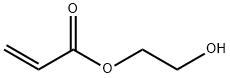
CAS No:818-61-1
MF:C5H8O3
Appearance:colorless transparent liquid
Specification:99.0%
UN number:-
Package:1/5/10/25kgs/drum
Supply Capacity:MT
Synonyms:2-Hydroxyethylester kyseliny akrylove;2-hydroxyethylesterkyselinyakrylove;2-Propenoicacid,2-hydroxyethylester;beta-Hydroxyethyl acrylate;beta-hydroxyethylacrylate;bisomer2hea;2-Hydroxyethyl acrylate, stabilized, 97%;ACRYLIC ACID 2-HYDROXYETHYL ESTER; 2-HYDROXYETHYL ACRYLATE; 818-61-1; Hydroxyethyl acrylate; 2-Propenoic acid, 2-hydroxyethyl ester; Ethylene glycol monoacrylate; Bisomer 2HEA; 2-(Acryloyloxy)ethanol; Ethylene glycol, acrylate; Acrylic acid, 2-hydroxyethyl ester; DTXSID2022123; Ethylene glycol, monoacrylate; 25GT92NY0C; beta-Hydroxyethyl acrylate; DTXCID202123; RefChem:6744; 212-454-9; 2-hydroxyethyl prop-2-enoate; 2-hydroxyethylacrylate; Acrylic acid 2-hydroxyethyl ester; 2-Hydroxyethylester kyseliny akrylove; 26403-58-7; CAS-818-61-1; CCRIS 3431; HSDB 1123; EINECS 212-454-9; MFCD00002865; BRN 0969853; UNII-25GT92NY0C; 2-Hydroxyethylester kyseliny akrylove [Czech]; hydroxyethylacrylate; MFCD00081878; hydroxylethyl acrylate; 2-hydroxylethylacrylate; 2-hydroxy-ethyl acrylate; EC 212-454-9; Hydroxyethyl acrylate polymer; .beta.-Hydroxyethyl acrylate; SCHEMBL14875; MLS002174257; SCHEMBL204415; SCHEMBL2512082; SCHEMBL7830905; SCHEMBL9115624; SCHEMBL9831446; CHEMBL1330518; HYDROXYETHYL ACRYLATE, 2-; acrylic acid 2-hydroxy-ethyl ester; Tox21_201430; Tox21_302968; AKOS015856805; 2-HYDROXYETHYL ACRYLATE [HSDB]; CS-W013616; FH32488; MSK165753-1000M; NCGC00090958-01; NCGC00090958-02; NCGC00256462-01; NCGC00258981-01; LS-13051; SMR001253953; A0743; NS00006157; 2-Hydroxyethyl Acrylate (stabilized with MEHQ); D78194; F461245; Q27253959; 2-Hydroxyethyl acrylate Solution in Methanol, 1000ug/mL; InChI=1/C5H8O3/c1-2-5(7)8-4-3-6/h2,6H,1,3-4H; Poly(oxy-1,2-ethanediyl), .alpha.-(1-oxo-2-propen-1-yl)-.omega.-hydroxy-; 2-Hydroxyethyl acrylate, 96%, contains 200-650 ppm monomethyl ether hydroquinone as inhibitor
Product application:Ethylene Glycol Monoacrylate,818-61-1,2-Hydroxyethyl acrylate,HEA,2-Propenoic acid 2-hydroxyethyl ester,2-Hydroxyethyl prop-2-enoate,Ethylene glycol acrylate,Acrylic acid 2-hydroxyethyl ester,Hydroxyl functional acrylate,UV reactive diluent,Radiation curing monomer,Thermosetting acrylic resin crosslinker,Two-pack polyurethane crosslinker,Contact lens hydrogel monomer,Biomedical polymer building block,Automotive OEM clearcoat resin,Low EGDA 2-hydroxyethyl acrylate,High purity 2-hydroxyethyl acrylate 99%,Water soluble acrylic monomer,UV adhesive monomer,Textile finishing polymer,CAS 818-61-1 supplier,Ethylene Glycol Monoacrylate manufacturer China,Suzhou Health Chemicals specialty acrylates,2-Hydroxyethyl acrylate wholesale bulk export
Ethylene Glycol Monoacrylate serves as an indispensable, ultra-pure hydroxyl-functional reactive acrylic monomer, benchmark radiation-curing active diluent, and versatile polymer crosslinking building block extensively utilized across automotive original equipment manufacturer (OEM) clearcoats, two-component polyurethane industrial finishes, ultraviolet (UV) and electron-beam (EB) curable coatings, optical adhesives, and hydrophilic hydrogel biomaterials sectors. In polymer synthesis and protective coating formulation, universally designated as 2-Hydroxyethyl acrylate or HEA, its molecular architecture uniquely integrates a free-radical polymerizable acrylate vinyl double bond alongside a nucleophilic terminal primary hydroxyl group; copolymerization with commercial methacrylates, butyl acrylate, and styrene readily incorporates pendant hydroxyl moieties along the acrylic polymer backbone to produce high-performance acrylic polyol resins; upon thermal curing or formulation with aliphatic polyisocyanates, these pendant hydroxyl functionalities undergo efficient polyaddition to establish durable, high-density polyurethane network crosslinks, imparting automobile clearcoats and industrial protective finishes with high gloss retention, scratch resistance, stone-chip resistance, and chemical resistance against harsh environmental acid rain and organic solvents; in radiation-curable coatings, inks, and electronic encapsulants, it operates as an effective low-viscosity reactive diluent and polarity modifier, accelerating free-radical photo-polymerization curing speeds while lowering formulation viscosity without volatile organic emissions; the presence of the hydroxyl group relaxes curing shrinkage stresses, yielding substrate wetting and adhesion over difficult non-polar plastic films, glass, ceramics, and metallic foils. In pressure-sensitive adhesives (PSAs), its incorporation introduces polar crosslinking anchor sites that enhance shear holding strength, cohesive integrity, and water-whitening resistance under high-humidity environments. In ophthalmology and biomedical engineering, owing to its aqueous miscibility and biocompatibility, it acts as a primary comonomer for copolymerizing transparent, oxygen-permeable, and hydrophilic hydrogels tailored for soft contact lenses, foldable intraocular lenses, sustained-release transdermal drug delivery matrix patches, and advanced biomedical wound-healing dressings. In textile finishing and papermaking chemicals, its water-dispersed copolymers improve dimensional fabric stability, fiber wrinkle resistance, and printability. Furthermore, in water-treatment polymeric antiscalants, photoresist dry films, and specialty synthetic lubricant additives, chemical systems engineered from Ethylene Glycol Monoacrylate deliver exceptional chemical reactivity, thin-film toughness, and broad multi-industry value.
Address:No. 338, Jingang Avenue, ZhangJiaGang City, Jiangsu Province, China. P.C.:215600Email:sales@healthchems.com
Tel:+86-512-58277800Fax:+86-512-58999904


