Your Location:Home > Products > Diethyl acetylenedicarboxylate
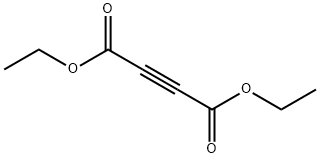
CAS No:762-21-0
MF:C8H10O4
Appearance:colorless or light-yellow transparent liquid
Specification:99.0%
UN number:-
Package:180kgs/drum
Supply Capacity:Tons
Synonyms:Bis-(Ethoxycarbonyl)acetylene;Diethyl 2-butynedioate;butynedioic acid diethyl ester;YL2-BUTYNEDIOATE;Diethyl but-2-yne-1,4-dioate;DIETHYL ACETYLENEDICARBOXYLATE;DIETHYL BUTYNEDIOATE;2-butynedioic acid diethyl ester
Product application:Diethyl acetylenedicarboxylate,762-21-0,DEAD,Diethyl but-2-ynedioate,Acetylenedicarboxylic acid diethyl ester,Diels-Alder dienophile,Cycloaddition reagent,Heterocyclic synthesis building block,Pharmaceutical intermediate CAS 762-21-0,Agrochemical intermediate,High purity Diethyl acetylenedicarboxylate,Organic synthesis raw material,Active alkyne diester,Polymer modifier,Diethyl acetylenedicarboxylate manufacturer China,CAS 762-21-0 supplier,Suzhou Health Chemicals alkyne intermediate,Diethyl acetylenedicarboxylate wholesale export
Diethyl acetylenedicarboxylate (CAS: 762-21-0) is an exceptionally versatile, electron-deficient acetylenic diester serving as a powerful dienophile and fundamental building block in advanced organic synthesis and medicinal chemistry. Benefiting from its highly activated carbon-carbon triple bond flanked by two ester functionalities, it is extensively utilized in classic Diels-Alder [4+2] cycloadditions as well as [3+2] and [2+2] dipolar cycloadditions to construct substituted carbocycles and diverse nitrogen- and oxygen-containing heterocycles, such as pyrazoles, pyrroles, pyridines, furans, and thiophenes. In the pharmaceutical sector, it serves as a critical intermediate for synthesizing antiviral agents, antitumor therapies, and kinase inhibitors. In agrochemistry, it is employed in developing innovative pesticides and herbicides. Additionally, in specialty materials science, it acts as a functional monomer and crosslinking modifier for engineering high-performance resins, optical polymers, and liquid crystal matrices.
Address:No. 338, Jingang Avenue, ZhangJiaGang City, Jiangsu Province, China. P.C.:215600Email:sales@healthchems.com
Tel:+86-512-58277800Fax:+86-512-58999904


