Your Location:Home > Products > Poly(3-hexylthiophene-2,5-diyl)
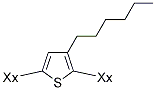
CAS No:104934-50-1
MF:(C10H18S)n
Appearance:red-brown or dark-brown solid powder
Specification:98.5%
UN number:-
Package:1/5/10/25kgs/drum
Supply Capacity:KGS
Synonyms:Poly(3-hexylthiophene-2,5-diyl) (regioregular electronic grade);Poly(3-hexylthiophene-2,5-diyl), average M.W. 30,000;Poly(3-hexylthienylene)Poly(hexyl-2,5-thiophenediyl)Poly(3-hexylthiophene-2,5-diyl);Poly(3-n-hexylthiophene);Poly(hexylthiophene);Poly(3-hexylthiophene-2,5-diyl), regioregular, low metals;P3HT, Plexcore(R) OS 2100;P3HT, Plexcore(R) OS 1100
Product application:Poly(3-hexylthiophene-2,5-diyl),104934-50-1,P3HT,Poly(3-hexylthiophene),Regioregular P3HT,RR-P3HT,Head-to-tail P3HT,Organic semiconductor polymer,Organic photovoltaic donor,Polymer solar cell active layer,Bulk heterojunction donor,p-type organic semiconductor,Organic thin-film transistor material,OTFT channel material,OFET active semiconductor,High hole mobility polymer,Solution-processable semiconductor,Perovskite solar cell HTL,Organic thermoelectric material,Printed electronics functional ink,Electronic grade conjugated polymer,High purity P3HT 98%,CAS 104934-50-1 supplier,P3HT manufacturer China,Suzhou Health Chemicals optoelectronic materials,P3HT wholesale bulk export
Poly(3-hexylthiophene-2,5-diyl) serves as an indispensable, ultra-pure conjugated polythiophene homopolymer, benchmark solution-processable p-type organic semiconductor, and versatile optoelectronic active material extensively utilized across organic photovoltaics (OPVs), organic thin-film transistors (OTFTs/OFETs), inverted perovskite solar cells, broadband photodetectors, printed electronics, and organic thermoelectrics sectors. In organic semiconductor physics and flexible device engineering, universally recognized as P3HT or Regioregular P3HT, its conjugated backbone is constructed of 3-hexylthiophene repeating units linked with high head-to-tail (HT) regioregularity (>95-98%), creating an extended one-dimensional pi-electron delocalization network; the flexible aliphatic hexyl side chains circumvent the extreme intractability of unfunctionalized polythiophenes, conferring robust solubility and solution rheology in industrial processing solvents such as chlorobenzene, o-dichlorobenzene, chloroform, and xylenes; this ensures compatibility with high-throughput deposition methodologies, including high-resolution inkjet printing, slot-die continuous coating, and gravure roll-to-roll manufacturing. In thin-film states, the high regioregularity drives spontaneous self-assembly into ordered, lamellar crystalline domains featuring dense face-to-face pi-pi stacking; this interchain ordering broadens optical absorption across the visible spectrum up to 650 nm and establishes continuous charge percolation pathways yielding field-effect hole mobilities exceeding 0.01 to 0.1 cm2/Vs with high on/off current ratios in OFETs. In organic solar cells, it functions as the standard benchmark electron donor blended with fullerene acceptors (such as PC61BM or ICBA) within bulk-heterojunction (BHJ) active layers, facilitating sub-picosecond exciton dissociation and bicontinuous hole transport with low bimolecular recombination. In inverted perovskite photovoltaics, it acts as a hydrophobic hole-extracting and passivating interlayer, forming a barrier against moisture intrusion while mitigating trap-assisted interfacial recombination. In organic thermoelectrics, molecularly doped P3HT films exhibit notable electrical conductivities and high power factors for flexible energy-harvesting devices. Furthermore, in electrochromic devices, antistatic conductive polymer blends, and specialized optoelectronic monitoring probes for petroleum and natural gas infrastructure, chemical systems engineered from Poly(3-hexylthiophene-2,5-diyl) deliver outstanding operational reproducibility, structural self-organization, and broad multi-industry performance.
Address:No. 338, Jingang Avenue, ZhangJiaGang City, Jiangsu Province, China. P.C.:215600Email:sales@healthchems.com
Tel:+86-512-58277800Fax:+86-512-58999904


