Your Location:Home > Products > Water Treatment > Poly (acrylic acid-co-hypophosphite) sodium salt; PCA
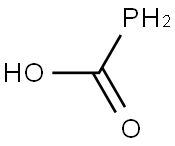
CAS No:71050-62-9
MF:(C3H4O2.H3O2P.Na)x
Appearance:colorless or light-yellow transparent liquid
Specification:30%/40%/50%
UN number:-
Package:1/5/10/25kgs/drum
Supply Capacity:MT
Synonyms:belsperse 164;PCA;Poly (acrylic acid-co-hypophosphite) sodium salt;Phosphino Carboxilic Acid (PCA);Phosphino Carboxylic Acid(PCA);2-Propenoic acid,polyMer with sodiuM phosphinate (1:1);Phaseolus coccineus agglutinin;PCA Phosphino Carboxylic Acid
Product application:Phosphino carboxylic acid,71050-62-9,PCA,Poly (acrylic acid-co-hypophosphite) sodium salt,Phosphino-carboxylic acid copolymer,Belsperse 164 alternative,Scale inhibitor and dispersant,Industrial water treatment chemical,Cooling water antiscalant,Low phosphorus water treatment,Reverse osmosis antiscalant,Oilfield scale inhibitor,Barium sulfate antiscalant,Strontium scale inhibitor,Detergent builder dispersant,Chlorine resistant antiscalant,Low free monomer PCA,High solid content PCA 50%,CAS 71050-62-9 supplier,Phosphino carboxylic acid manufacturer China,Suzhou Health Chemicals water treatment additives,PCA bulk wholesale export
Phosphino carboxylic acid is widely utilized across heavy industrial circulating cooling water stabilization at high cycles of concentration, oilfield produced-water reinjection and artificial lift downhole scale mitigation, seawater reverse osmosis (SWRO) membrane descaling protection, industrial boiler water conditioning, low-phosphorus detergent builder formulation, and textile dyeing auxiliary dispersing sectors. In water treatment engineering and aquatic physical chemistry, universally recognized in industrial scale management as PCA or Poly (acrylic acid-co-hypophosphite) sodium salt, it functions as a high-performance, low-phosphorus polymeric antiscalant and particulate dispersant; by integrating phosphorus-containing phosphino handles directly into a polyacrylic acid backbone during radical polymerization, the copolymer delivers combined chemical functions: the carboxylate domains contribute dense negative charge for colloidal dispersion and threshold inhibition, while the phosphino groups impart crystal lattice distortion; this bifunctional synergy interrupts nucleation and forces crystallizing ions to undergo structural deformation, preventing stubborn mineral deposition onto heat exchanger surfaces and composite reverse osmosis polyamide membranes; its primary industrial advantage over standard polyacrylates resides in its exceptional inhibition efficiency against notoriously intractable scales, including barium sulfate, strontium sulfate, and complex silica-iron matrices under severe hyper-saline conditions; furthermore, the copolymer exhibits chemical stability against thermal degradation and strong oxidizing biocides such as free chlorine, hypochlorite, and bromine without hydrolytic cleavage; in liquid detergent and industrial cleaning formulation, Phosphino carboxylic acid serves as an efficient builder that sequesters multivalent hardness cations and suspends soil particulates to prevent fabric encrustation and redeposition across demanding commercial operations.
Address:No. 338, Jingang Avenue, ZhangJiaGang City, Jiangsu Province, China. P.C.:215600Email:sales@healthchems.com
Tel:+86-512-58277800Fax:+86-512-58999904


