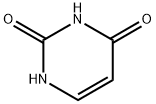
CAS No:66-22-8
MF:C4H4N2O2
Appearance:white or off-white crystalline powder
Specification:98.5%
UN number:-
Package:1/5/10/25kgs/drum
Supply Capacity:MT
Synonyms:COATED SAFETY BOTTLE 2,5LWITHOUT CAP ISO;ALUMINIUM CAN WITH HANDLE AND STOPPER;Uracyl;4-Hydroxy-2(1H)-pyrimidinone;Hybar X;hybarx;Pirod;Pyrod; uracil; 66-22-8; pyrimidine-2,4(1H,3H)-dione; 2,4(1H,3H)-Pyrimidinedione; Pyrod; Hybar X; Pirod; 2,4-Dioxopyrimidine; 2,4-Pyrimidinedione; 1H-Pyrimidine-2,4-dione; 1,2,3,4-tetrahydropyrimidine-2,4-dione; DTXSID4021424; 56HH86ZVCT; NSC-3970; SQ-6201; SQ-7726; SQ-8493; CHEBI:17568; BMS-205603-01; NSC3970; DTXCID101424; 2, 4-Dioxopyrimidine; RefChem:6338; 2-hydroxy-4-(1H)-pyrimidione; 2-hydroxy-4-(3H)-pyrimidione; 4-hydroxy-2-(1H)-pyrimidione; 200-621-9; 2,4-Dihydroxypyrimidine; pyrimidine-2,4-diol; 2,4-Pyrimidinediol; 51953-14-1; Uracil [USAN]; RU 12709; MFCD00006016; 2-Hydroxy-4(3H)-pyrimidinone; NSC 3970; Ura; CCRIS 3077; 2-Hydroxy-4(1H)-pyrimidinone; SQ 6201; SQ 7726; SQ 8493; BMS 205603-01; AI3-25470; 2,4-Pyrimidinediol (9CI); Lamivudine impurity e; 4-Hydroxy-2(1H)-pyrimidinone; 66255-05-8; Lamivudine impurity e rs; NCIMech_000782; Fluorouracil specified compound c; Pharmakon1600-01502345; Uracil, >=99.0% (T); NSC29742; NSC-29742; STK301734; NCGC00181030-01; URACIL (USP-RS); URACIL [USP-RS]; URACIL (MART.); URACIL [MART.]; 4-Hydroxyuracil; 2,4(1H,3H)-Pyrimidinedione; 2,4-Dihydroxypyrimidine; 2,4-Pyrimidinediol; CAS-66-22-8; Pyrimidine-2,4(1H,3H)-dione (Uracil); Uracil (8CI); Uracil [USAN:JAN]; 2(1H)-Pyrimidinone, 4-hydroxy-; 2(1H)-Pyrimidinone, 6-hydroxy-; 4(3H)-Pyrimidinone, 2-hydroxy-; EINECS 200-621-9; UNII-56HH86ZVCT; Uracyl; Urazil; 66224-60-0; 8h-uracil; hydroxypyrimidinone; Uracil;Lamivudine EP Impurity F;
Fluorouracil EP Impurity C;
Cytarabine EP Impurity D; Uracil (Standard); 2,6-Dioxypyrimidin; 2,4-Dioxypyrimidine; 144104-68-7; 2,4(1H,3H)-Pyrimidinedione (9CI); pyrimidine-2,4-dione; Uracil, 99%; 1ui0; Uracil (JAN/USAN); 2,3H)-Pyrimidinedione; 2,6-Dihydroxypyrimidine; Osimertinib Impurity 65; URACIL [JAN]; URACIL [WHO-DD]; Lamivudine EP Impurity F; URACIL [MI]; bmse000187; bmse000940; CHEMBL566; Epitope ID:120356; SCHEMBL8235; Fluorouracil impurity C CRS; Uracil, >=99.0%; pyrimidine, 2,4-dihydroxy-; SCHEMBL29730; SCHEMBL80962; SCHEMBL94310; 51953-19-6; MLS001304993; SCHEMBL144010; SCHEMBL151239; SCHEMBL537174; SCHEMBL877869; SCHEMBL925137; GTPL4560; orb1224304; orb1310972; SCHEMBL1050479; SCHEMBL5089507; SCHEMBL6286831; SCHEMBL6434097; SCHEMBL6434098; SCHEMBL7267501; SCHEMBL7335265; SCHEMBL9734266; SCHEMBL9779787; 2,4-(1h,3h)-pyrimidinedione; SCHEMBL10580164; SCHEMBL11607890; SCHEMBL13276278; SCHEMBL29525634; SCHEMBL31434533; HY-I0960R; 1,3-dihydropyrimidine-2,4-dione; HMS2234E19; HMS3264C13; HMS3373E18; HMS3652N05; HMS5082D06; 4(1H)-Pyrimidinone, 2-hydroxy-; HY-I0960; ZAA89752; Tox21_112680; Tox21_201023; BDBM50549809; CCG-35866; EBC-13197; MSK000882; NSC759649; s4177; SBB058492; STL124066; AKOS000119989; AKOS002303991; Tox21_112680_1; CCG-213042; CS-W020104; DB03419; FU01843; NSC-759649; PS-5279; SB55489; SB55884; NCGC00181030-02; NCGC00247663-01; NCGC00258576-01; Uracil, Vetec(TM) reagent grade, 98%; NCI60_003718; SMR000752912; SY008943; DB-030518; DB-103964; DB-268940; DB-268966; DB-272084; DB-272202; LAMIVUDINE IMPURITY F [EP IMPURITY]; FLUOROURACIL IMPURITY C [EP IMPURITY]; LAMIVUDINE IMPURITY E [USP IMPURITY]; NS00002070; ST45061548; SW220239-1; U0013; U6901; EN300-17138; Uracil, suitable for cell culture, BioReagent; C00106; D00027; SBI-0053640.0002; AB00171810_03; AB00171810_04; AB00918623-05; AC-907/30002021; F036407; Q182990; BRD-K80129304-001-08-1; BRD-K80129304-001-09-9; Z56889474; F1796-0008; FLUOROURACIL SPECIFIED COMPOUND C [USP IMPURITY]; E2FC11E5-1887-46DF-B415-82313CE9B2BD; Uracil, United States Pharmacopeia (USP) Reference Standard; Uracil; Lamivudine EP Impurity F; Fluorouracil EP Impurity C; Fluorouracil impurity C, European Pharmacopoeia (EP) Reference Standard; InChI=1/C4H4N2O2/c7-3-1-2-5-4(8)6-3/h1-2H,(H2,5,6,7,8; Uracil, Pharmaceutical Secondary Standard; Certified Reference Material
Product application:Uracil,66-22-8,2 4-Dihydroxypyrimidine,2 4(1H 3H)-Pyrimidinedione,Pyrimidine-2 4-dione,Natural pyrimidine base,Pharmaceutical grade Uracil,Antineoplastic API intermediate,5-Fluorouracil synthesis raw material,5-FU precursor,Tegafur starting material,Antiviral intermediate,Uridine synthesis precursor,Cytidine raw material,Nucleic acid building block,RNA transcription monomer,Pseudouridine precursor,mRNA vaccine modified nucleoside raw material,Agrochemical intermediate,Herbicide building block,Cell culture medium component,Research biochemical CAS 66-22-8,High purity Uracil 99%,Uracil manufacturer China,CAS 66-22-8 supplier,Suzhou Health Chemicals pyrimidines,Uracil wholesale bulk export
Uracil serves as an indispensable natural pyrimidine base, vital structural building block, and versatile metabolic precursor extensively utilized across the pharmaceutical oncology, nucleic acid biotechnology, fine agrochemical, and life science research sectors. In commercial active pharmaceutical ingredient (API) manufacturing and antineoplastic chemical synthesis, functioning as a primary heterocyclic scaffold, it is the foundational starting raw material for synthesizing frontline antimetabolite chemotherapy agents, notably 5-Fluorouracil (5-FU), Tegafur, and Doxifluridine; these therapeutic analogues exert targeted cytotoxic activity by irreversibly inhibiting thymidylate synthase and incorporating false pyrimidines into neoplastic RNA/DNA, making them indispensable in clinical treatment protocols for colorectal, gastric, and breast carcinomas. In modern RNA therapeutics and mRNA vaccine manufacturing, Uracil is a vital substrate for producing therapeutic nucleoside analogues, Uridine, and key modified nucleotides such as N1-methylpseudouridine to suppress innate immune recognition and maximize translational efficiency. In fine agrochemical formulation, it serves as a critical reactive intermediate in synthesizing high-efficiency selective herbicides, including Terbacil and Pyribenzoxim, as well as novel pyrimidine-based plant protection agents. Furthermore, in molecular genetics and biotechnology, Uracil is widely applied in yeast URA3 auxotrophic counterselection systems, nucleic acid sequencing methodologies, and as an essential pyrimidine supplement in serum-free cell culture media.
Address:No. 338, Jingang Avenue, ZhangJiaGang City, Jiangsu Province, China. P.C.:215600Email:sales@healthchems.com
Tel:+86-512-58277800Fax:+86-512-58999904


