Your Location:Home > Products > trans-N,N'-Dimethyl-1,2-cyclohexanediamine
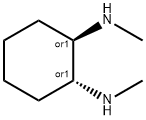
CAS No:67579-81-1
MF:C8H18N2
Appearance:colorless or light-yellow transparent liquid
Specification:98.5%
UN number:UN 2735 8/PG II
Package:1/5/10/25kgs/drum
Supply Capacity:Tons
Synonyms:trans-N,N;trans-(1R,2R)-N,N'-BisMethyl-1,2-cyclohexanedia;1,2-CyclohexanediaMine,N1,N2-diMethyl-, (1R,2R)-rel-;trans-N,N'-DiMethylcyclohexane-1,2-diaMin;rel-(1R,2R)-N1,N2-DiMethylcyclohexane-1,2-diaMine;trans-N1,N2-DiMethylcyclohexane-1,2-diaMine;(1R,2R)-rel-N1,N2-DiMethylcyclohexane-1,2-diaMine;TRANS-1,2-BIS(METHYLAMINO)CYCLOHEXANE
Product application:trans-N,N'-Dimethyl-1,2-cyclohexanediamine,67579-81-1,trans-N,N'-Dimethylcyclohexane-1,2-diamine,N,N'-Dimethyl-trans-1,2-cyclohexanediamine,Bidentate nitrogen ligand,Copper-catalyzed Ullmann reaction ligand,C-N cross-coupling ligand,C-O bond formation catalyst,Transition metal ligand,Buchwald-Hartwig amination ligand,Pharmaceutical intermediate CAS 67579-81-1,Organic synthesis building block,Arylation catalyst ligand,Optoelectronic material intermediate,High purity trans ligand 99%,Research biochemical,Fine chemical intermediate,trans-N,N'-Dimethyl-1,2-cyclohexanediamine manufacturer China,CAS 67579-81-1 supplier,Suzhou Health Chemicals organic ligands,Ullmann ligand wholesale bulk export
trans-N,N'-Dimethyl-1,2-cyclohexanediamine serves as an indispensable, high-efficiency bidentate diamine ligand and versatile chemical building block extensively utilized across the pharmaceutical, fine agrochemical, organic synthesis, and advanced materials sectors. In the synthetic development and commercial manufacturing of active pharmaceutical ingredients (APIs), it coordinates robustly with transition metals such as copper, palladium, and nickel to generate highly active catalytic systems; it is particularly renowned for promoting modified Ullmann-type cross-coupling reactions under mild conditions, facilitating carbon-nitrogen (C-N) and carbon-oxygen (C-O) bond formations between aryl halides and various amines, amides, phenols, or nitrogen heterocycles with exceptional yields and selectivity, making it a critical process tool for constructing complex bioactive scaffolds. In agrochemical engineering, it functions as a vital catalytic auxiliary in synthesizing next-generation fungicides, insecticides, and selective herbicides. In the functional materials and optoelectronics industry, it is widely utilized to catalyze the assembly of specialty conjugated polymers, OLED hole-transport materials, and high-performance liquid crystal monomers. Furthermore, in academic and industrial chemical research, this diamine remains a standard benchmark ligand for investigating novel organometallic mechanisms and developing sustainable, cost-effective cross-coupling methodologies.
Address:No. 338, Jingang Avenue, ZhangJiaGang City, Jiangsu Province, China. P.C.:215600Email:sales@healthchems.com
Tel:+86-512-58277800Fax:+86-512-58999904


