Your Location:Home > Products > Hypoxanthine
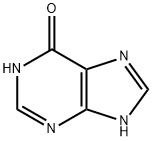
CAS No:68-94-0
MF:C5H4N4O
Appearance:white or light-yellow crystalline powder
Specification:98.5%
UN number:-
Package:1/5/10/25kgs/drum
Supply Capacity:MT
Synonyms:HYPOXANTHINE ANHYDROUS;Hypoxanthine, 99.5%;Hypoxanthinee;HYPOXANTHINE(RG);6-HYDROXYPURINE(HYPOXANTHINE);purine-6(1H)-one;Hypexanthine;6-oxypurine; hypoxanthine; 68-94-0; 6-Hydroxypurine; 9H-Purin-6-ol; 7H-Purin-6-ol; Sarkin; 3H-Purin-6-ol; Sarcine; 1,7-Dihydro-6H-purin-6-one; 6-Oxopurine; Sarkine; Hypoxanthine enol; Purin-6(1H)-one; 6-Hydroxy-1H-purine; Purin-6-ol; 9H-Purin-6(1H)-one; 6(1H)-Purinone; Purin-6(3H)-one; 6H-Purin-6-one, 1,7-dihydro-; Purine-6-ol; 6,7-dihydro-3H-purin-6-one; DTXSID8045983; CHEBI:17368; 2TN51YD919; NSC-14665; DTXCID6025983; NSC14665; RefChem:789621; 200-697-3; 1h-purin-6-ol; 1,9-dihydro-6H-purin-6-one; 146469-94-5; 1,7-Dihydro-6H-purine-6-one; 3,7-dihydropurin-6-one; 95121-06-5; 146445-70-7; 146469-95-6; 51953-04-9; 1H-Purin-6-ol (9CI); 6H-Purin-6-one, 1,9-dihydro-; Hypoxanthine (VAN); 9H-Purin-6-ol (VAN); MFCD00005725; NSC 14665; 3h-hypoxanthine; 6H-Purin-6-one, 3,7-dihydro- (9CI); HX; AI3-52242; Spectrum_001417; CHEMBL1427; GTPL4555; PDSP2_000297; STK804424; AKOS000267572; CAS-68-94-0; NCGC00095622-01; Discontinued. See H998503 or H998504; Hypoxsanthine (1,7-Dihydro-6H-purin-6-one); 1H-Purin-6(9H)-one; F1386-0269; 146469-96-7; 1,7-Dihydro-6H-purin-6-one (Hypoxanthine); purin-6(1H)-on; EINECS 200-697-3; Hypoxanthinee; UNII-2TN51YD919; 6-hydroxypurin; 6-oxypurine; 6-purinol; 1vfn; 3nrz; Hypoxanthine, 99%; purine, 6-hydroxy-; 1H,7H-Hypoxanthine; NSC 129419; 4-Hydroxy-1H-purine; 1a9q; Hypoxanthine (Standard); 7H-Purin-6-ol #; SpecPlus_000461; Spectrum2_001907; Spectrum3_001352; Spectrum4_001742; Spectrum5_000564; HYPOXANTHINE [MI]; 1,9-dihydropurin-6-one; Didanosine impurity A CRS; 3H-Purin-6(9H)-one; bmse000094; Epitope ID:167471; 1,9-Dihydro-purin-6-one; Hypoxanthine, >=99.0%; SCHEMBL25381; SCHEMBL25382; SCHEMBL25383; BSPBio_003163; KBioGR_002184; KBioSS_001897; Mercaptopurine EP Impurity A; SPECTRUM310023; 51953-23-2; Hypoxanthine (VAN) (8CI); DivK1c_006557; HYPOXANTHINE [WHO-DD]; Mercaptopurine impurity A CRS; SCHEMBL158472; SCHEMBL158473; SCHEMBL275944; SCHEMBL275945; SCHEMBL355917; SCHEMBL440223; SCHEMBL446722; SCHEMBL822613; SPBio_001874; orb1224235; orb1308844; orb3025461; SCHEMBL1867923; SCHEMBL3245216; SCHEMBL3696833; SCHEMBL4361878; SCHEMBL8012415; SCHEMBL8079826; SCHEMBL8169178; SCHEMBL9043222; SCHEMBL9047405; 6,7-dihydro-1H-purin-6-one; 3,7-Dihydro-6H-purin-6-one; 3,9-Dihydro-6H-purin-6-one; SCHEMBL14793560; SCHEMBL17276814; SCHEMBL21332344; SCHEMBL30633160; BDBM82018; FDGQSTZJBFJUBT-UHFFFAOYSA-; HY-N0091R; KBio1_001501; KBio2_001897; KBio2_004465; KBio2_007033; KBio3_002383; CAS_790; MSK6923; NSC_790; HMS5087P17; 6H-Purin-6-one, 3,7-dihydro-; 6H-Purin-6-one, 3,9-dihydro-; SMSSF-0040850; FDC26504; HY-N0091; Tox21_111511; CCG-38478; EBC-06261; EBC-48055; MSK6923-100W; PDSP1_000299; s2424; SBB004203; AKOS005221762; AKOS009159101; AKOS015888571; AKOS022168213; MSK6923-1000W; Tox21_111511_1; DB04076; FH02949; PS-3167; SDCCGMLS-0065594.P001; SDCCGMLS-0065594.P002; NCGC00095622-04; AC-10518; AC-32451; SY012477; Hypoxanthine Solution in Water, 100ug/mL; DB-029904; DB-264101; DB-273114; DB-273118; DB-273292; DB-325530; DIDANOSINE IMPURITY A [EP IMPURITY]; Hypoxanthine Solution in Water, 1000ug/mL; AZATHIOPRINE IMPURITY F [EP IMPURITY]; CS-0007792; H0311; H9763; NS00010150; ST50160486; SW219908-1; EN300-37579; Hypoxanthine, Vetec(TM) reagent grade, 98%; C00262; Hypoxanthine, Low endotoxin: <= 0.04 EU/mg; M01853; AB00674258-01; AC-907/21098001; AG-670/31547063; Mercaptopurine EP Impurity A;
Hypoxanthine; Q410305; SR-05000002375; SR-05000002375-1; Azathioprine EP Impurity F; Didanosine EP Impurity A; BRD-K03739921-001-06-8; Z1954805546; Hypoxanthine, powder, BioReagent, suitable for cell culture; MERCAPTOPURINE IMPURITY, HYPOXANTHINE- [EP IMPURITY]; 8C229956-6BE8-4F8D-91B7-0AD1EC294077; MERCAPTOPURINE IMPURITY, HYPOXANTHINE- [USP IMPURITY]; Tenofovir disoproxil Impurity 40(Azathioprine EP Impurity F); Didanosine impurity A,, European Pharmacopoeia (EP) Reference Standard; InChI=1/C5H4N4O/c10-5-3-4(7-1-6-3)8-2-9-5/h1-2H,(H2,6,7,8,9,10)
Product application:Hypoxanthine,68-94-0,6-Hydroxypurine,Purin-6-ol,1H-Purin-6-one,Sarcine,Cell culture grade hypoxanthine,HAT medium component,HT medium additive,Hybridoma selection reagent,Monoclonal antibody bioproduction,Purine salvage pathway precursor,Acyclovir intermediate,Ganciclovir raw material,Nucleoside analogue building block,Antiviral drug intermediate,Antineoplastic synthon,Fish freshness K value standard,Hypoxanthine oxidase substrate,Cosmetic grade hypoxanthine,Fibroblast revitalizing agent,High purity Hypoxanthine 99.5%,CAS 68-94-0 supplier,Hypoxanthine manufacturer China,Suzhou Health Chemicals biochemicals,Hypoxanthine wholesale bulk export
Hypoxanthine finds widespread and practical utility across monoclonal antibody hybridoma engineering, large-scale mammalian cell biomanufacturing, antiviral active pharmaceutical ingredient total synthesis, food cold-chain freshness biosensing, and advanced cellular anti-aging personal care sectors. In biotechnology and therapeutic antibody development, universally designated as 6-hydroxypurine across life sciences, it operates as an irreplaceable nutrient component in HAT (hypoxanthine-aminopterin-thymidine) and HT selection media; when aminopterin blocks the de novo nucleotide synthesis pathway in cultured myelomas, only successfully fused hybridomas harboring functional hypoxanthine-guanine phosphoribosyltransferase (HGPRT) utilize exogenous hypoxanthine via the nucleotide salvage pathway to regenerate inosine monophosphate, enabling the selective expansion of antibody-secreting clonal colonies; in serum-free and chemically defined CHO bioprocessing media, precision hypoxanthine supplementation optimizes cellular bioenergetics, enhancing cell viability, prolonging production phases, and elevating titers of recombinant fusion proteins and therapeutic enzymes; in commercial pharmaceutical manufacturing, its purine bicyclic architecture functions as the foundational heterocyclic starting raw material for synthesizing frontline antiviral therapeutics, including acyclovir, valacyclovir, and ganciclovir, as well as immunosuppressive and antineoplastic agents like 6-mercaptopurine, providing the critical structural framework that competitively inhibits viral DNA polymerases; in agricultural food technology and marine post-harvest quality control, post-mortem muscular ATP degradation predictably generates hypoxanthine as an end-stage catabolite, making the compound the international chemical reference standard for determining the K-value freshness index across fresh fish and poultry via enzymatic hypoxanthine oxidase electrochemical biosensors and freshness test strips; furthermore, in clinical dermatological cosmeceuticals and facial serums, Hypoxanthine operates as an endogenous nucleotide precursor that stimulates dermal fibroblast viability, promoting cellular turnover, boosting extracellular matrix collagen expression, and mitigating UV-induced photoaging.
Address:No. 338, Jingang Avenue, ZhangJiaGang City, Jiangsu Province, China. P.C.:215600Email:sales@healthchems.com
Tel:+86-512-58277800Fax:+86-512-58999904


