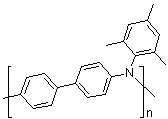
Your Location:Home > Products > Poly[[(2,4,6-trimethylphenyl)imino][1,1'-biphenyl]-4,4'-diyl]; PTAA
CAS No:1333317-99-9
MF:(C21H19N)n
Appearance:light-yellow or yellow solid powder
Specification:98.5%
UN number:-
Package:1/5/10/25kgs/drum
Supply Capacity:KGS
Synonyms:Poly[bis(4-phenyl)(2,4,6-triMethylphenyl)aMine];PTAA(Mn15000-25000);PTAA(Mn6000-15000);Poly[bis(4-phenyl)(2,4,6-triMethylphenyl)aMine] a poly(triaryl aMine) seMiconductor;PTAA a poly(triaryl amine) semiconductor;Poly[[(2,4,6-trimethylphenyl)imino][1,1'-biphenyl]-4,4'-diyl];PTAA, average Mn: 17,000;PTAA, average Mn: 20,000 - 40,000; 2,4,6-Trimethyl-N,N-diphenylaniline; 603134-65-2; DTXSID70599416; RefChem:1059634; DTXCID40550175; 1333317-99-9; N,N-diphenyl-2,4,6-triMethyl aniline; PTAA; Poly[bis(4-?phenyl)?(2,4,6-?trimethylphenyl)?amine]; SCHEMBL3477723; TZJRFZZCRASCAW-UHFFFAOYSA-N; AKOS022172920; 2,4,6-trimethyl-N,N-diphenyl-aniline; Poly(2,4,6-trimethyl-N,N-diphenylaniline); H37350; TAA; N,N-diphenyl-2,4,6-trimethylaniline, >99%(HPLC), Sublimed
Product application:Poly[[(2,4,6-trimethylphenyl)imino][1,1'-biphenyl]-4,4'-diyl],1333317-99-9,PTAA derivative,Polytriarylamine analogue,Poly(biphenyl-triarylamine),Hole transport polymer,Hole transport layer material,HTL polymer,Perovskite solar cell hole conductor,Perovskite HTL material,Hydrophobic hole transport layer,OLED hole transporting material,QLED hole transport polymer,Printed electronics functional polymer,High hole mobility polymer,Solution-processable semiconducting polymer,Organic semiconductor polymer,Electronic grade conjugated polymer,High purity PTAA polymer,CAS 1333317-99-9 supplier,Hole transport polymer manufacturer China,Suzhou Health Chemicals optoelectronic materials,HTL materials wholesale bulk export
Poly[[(2,4,6-trimethylphenyl)imino][1,1'-biphenyl]-4,4'-diyl] serves as an indispensable, ultra-pure conjugated polytriarylamine derivative, benchmark solution-processable hole-transporting polymer, and versatile interfacial modifier extensively utilized across perovskite solar cells (PSCs), quantum-dot light-emitting diodes (QLEDs), organic light-emitting diodes (OLEDs), organic field-effect transistors (OFETs), and printed flexible electronics sectors. In photovoltaic device physics and thin-film solar engineering, widely deployed as a sterically optimized PTAA-class hole-transporting layer (HTL) active material, its molecular architecture incorporates alternating biphenyl bridges and electron-rich 2,4,6-trimethylaniline moieties covalently coupled along a continuous conjugated backbone; it exhibits an optimal highest occupied molecular orbital (HOMO) energy level situated between -5.15 eV and -5.30 eV, which establishes barrier-free thermodynamic band alignment with both organic-inorganic hybrid and all-inorganic perovskite absorber valance bands to drive ultra-fast hole extraction; concurrently, its shallow lowest unoccupied molecular orbital (LUMO) energy level creates a robust potential barrier that blocks unwanted electron leakage toward the positive electrode, suppressing interfacial non-radiative recombination losses and maximizing device open-circuit voltages. The steric hindrance imparted by the ortho-methyl substituents on the mesityl rings twists adjacent aromatic rings out of coplanarity, which suppresses deleterious polymer aggregation-induced quenching while simultaneously imparting pronounced nanoscale surface hydrophobicity with water contact angles exceeding 90 degrees; this hydrophobic character acts as a durable moisture-barrier shield protecting the delicate perovskite crystal lattice from ambient moisture degradation, drastically prolonging operational stability under continuous illumination, heat, and relative humidity. In advanced display technology, including inkjet-printed QLEDs and OLEDs, it serves as a smooth, chemically stable hole-transporting interlayer that optimizes balanced carrier recombination in the emissive core. In broadband photodetector arrays and organic transistors, it minimizes dark leakage currents while delivering elevated hole mobilities to maximize transient frequency response. Furthermore, in antistatic functional coatings, conductive polymer blends, and specialized optoelectronic monitoring probes for petroleum and natural gas infrastructure, chemical systems engineered from Poly[[(2,4,6-trimethylphenyl)imino][1,1'-biphenyl]-4,4'-diyl] deliver exceptional electrochemical stability, reproducible thin-film morphology, and broad multi-industry performance.
Address:No. 338, Jingang Avenue, ZhangJiaGang City, Jiangsu Province, China. P.C.:215600Email:sales@healthchems.com
Tel:+86-512-58277800Fax:+86-512-58999904


