Your Location:Home > Products > Boc-L-Valine
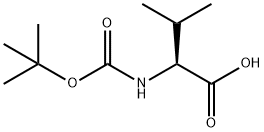
CAS No:13734-41-3
MF:C10H19NO4
Appearance:white or off-white crystalline powder
Specification:98.5%
UN number:-
Package:1/5/10/25kgs/drum
Supply Capacity:MT
Synonyms:Bok - L - valine;Boc-Val-OH >=99.0% (T);(2S)-3-methyl-2-[(2-methylpropan-2-yl)oxycarbonylamino]butanoic acid;Valine, N-carboxy-, N-tert-butyl ester, L- (8CI);(2S)-2-[(tert-butoxy-oxomethyl)amino]-3-methylbutanoic acid;BOC-VALINE-OH;BOC-L-VALINE-OH;Boc-L-valine≥ 99% (HPLC); Boc-L-valine; 13734-41-3; L-Valine, N-[(1,1-dimethylethoxy)carbonyl]-; L-Valine, N-((1,1-dimethylethoxy)carbonyl)-; DTXSID50884635; RefChem:1080068; DTXCID401024065; Boc-Val-OH; N-(tert-Butoxycarbonyl)-L-valine; N-Boc-L-valine; Boc-L-Val-OH; tert-Butoxycarbonylvaline; (S)-2-(Boc-amino)-3-methylbutyric acid; MFCD00065605; N-tert-Butyloxycarbonyl-L-valine; Boc-valine; (S)-2-((tert-Butoxycarbonyl)amino)-3-methylbutanoic acid; N-tert-Butoxycarbonyl-L-valine; N-t-butyloxycarbonyl-N-methyl-L-valine; N-tert-Butoxycarbonylvaline; tert-Butoxycarbonyl-L-valine; (2S)-3-methyl-2-[(2-methylpropan-2-yl)oxycarbonylamino]butanoic acid; (TERT-BUTOXYCARBONYL)-L-VALINE; 28R8GK7LBC; N-((1,1-Dimethylethoxy)carbonyl)-L-valine; (2S)-2-[(tert-butoxycarbonyl)amino]-3-methylbutanoic acid; Valine, N-carboxy-, N-tert-butyl ester, L-; (2S)-2-(tert-butoxycarbonylamino)-3-methyl-butanoic acid; (2S)-2-{[(tert-butoxy)carbonyl]amino}-3-methylbutanoic acid; N-[(1,1-Dimethylethoxy)carbonyl]-L-valine; M03340; (2S)-2-[(tert-butoxy)carbonylamino]-3-methylbutanoic acid; (2S)-2-[[(tert-butoxy)carbonyl]amino]-3-methylbutanoic acid; valine, N-[(1,1-dimethylethoxy)carbonyl]-; BocValOH; N-Boc valine; Boc-ValOH; N-BOC-valine; N-t-boc-l-val; (s)-n-boc-valine; BOC-L-Valin; EINECS 237-307-6; n-boc-(l)-valine; (S)-Boc-Valine; Boc-(L)-Valine; t-butoxycarbonylvaline; Boc-NH-Val-OH; N-Boc-Val-OH; NSC 197197; Boc-(L)-Val; BOC-VAL; BOC-VALINE-OH; Boc-(L)-Val-OH; N-t-butoxycarbonylvaline; (S)-2-(BOC-AMINO)PENTANOIC ACID; t-butoxycarbonyl-L-valine; UNII-28R8GK7LBC; EC 237-307-6; N-t-butyloxycarbonyl-valine; t-butyloxycarbonyl-L-valine; SCHEMBL59323; N-t-butyloxycarbonyl-L-valine; Tert-butyloxycarbonyl-L-valine; N-(t-butoxycarbonyl)-L-valine; N-tert-butoxycarbonyl L-valine; (S)-2-(tert-butoxycarbonylamino)-3-methylbutanoic acid; (S)-N-tert-butoxycarbonylvaline; CHEMBL5305170; Tertiarybutyloxycarbonyl-L-valine; N-(tert -butoxycarbonyl)-valine; N-(tert-butoxycarbony1)-L-valine; ALBB-015814; N-(tert-butyloxycarbonyl)-L-valine; N-tert-butyloxycarbonyl-(L)-valine; N-((tert-Butoxy)carbonyl)-L-valine; N-(tert-Butoxycarbonyl)-(L)-valine; SBB028543; AKOS005175164; AKOS015841611; Boc-Val-OH, >=99.0% (T); CS-W002300; EBC-253218; FB02702; HY-W002300; AC-17119; AS-12728; BP-12966; BP-23488; PD196389; SY007790; ST50307217; EN300-52854; N-{[(1,1-dimethylethyl)oxy]carbonyl}-L-valine; (2s)-tert-butoxycarbonylamino-3-methylbutyric acid; (S)-2-tertbutoxycarbonylamino-3-methylbutyric acid; (s)-2-tert-butoxycarbonylamino-3-methylbutyric acid; (S)-2-(t-butoxycarbonylamino)-3-methylbutanoic acid; (S)-2-tert-butoxycarbonylamino-3-methyl-butyric acid; (S)-2-tert-butoxycarbonylamino-3-methylbutanoic acid; F0001-0471; Z756432558; (S)-2-((tert-butoxycarbonyl) amino)-3-methylbutanoic acid; (S)-2-[[(tert-butoxy)carbonyl]amino]-3-methylbutanoic acid; (2S)-2-[(1,1-dimethylethoxy)carbonylamino]-3-methylbutanoic acid
Product application:Boc-L-Valine,13734-41-3,N-(tert-Butoxycarbonyl)-L-valine,Boc-Val-OH,N-Boc-L-valine,(2S)-2-(tert-Butoxycarbonylamino)-3-methylbutanoic acid,Boc-L-Val-OH,Peptide synthesis grade Boc-L-valine,Boc-protected amino acid,Solid phase peptide synthesis building block,SPPS synthon,Chiral amino acid derivative,Daclatasvir intermediate,Valacyclovir precursor,Proteasome inhibitor building block,Antiviral intermediate,Chiral oxazoline ligand precursor,Asymmetric catalysis intermediate,High purity Boc-L-valine 99.5%,CAS 13734-41-3 supplier,Boc-L-Valine manufacturer China,Suzhou Health Chemicals peptide reagents,Boc-L-Valine wholesale bulk export
Boc-L-Valine finds widespread and practical utility across commercial therapeutic peptide synthesis, frontline antiviral active pharmaceutical ingredient (API) manufacturing, targeted proteasome inhibitor oncology discovery, proteolysis targeting chimera (PROTAC) linker design, and asymmetric coordination catalysis sectors. In peptide chemistry and process pharmacology, universally designated as Boc-Val-OH or N-tert-butoxycarbonyl-L-valine, it serves as an indispensable homochiral building block for solid-phase peptide synthesis (SPPS) and liquid-phase fragment condensation; its molecular architecture pairs a hydrophobic isopropyl branched side chain with a carbamate-masked alpha-amino terminus and a free carboxylic acid handle; the tert-butoxycarbonyl (Boc) protecting group suppresses unwanted self-condensation and nucleophilic side attacks during carboxyl activation, enabling peptide bond coupling with high regioselectivity when mediated by carbodiimide or uronium-type coupling reagents; subsequent acidolytic deprotection under mild trifluoroacetic acid cleanly liberates the primary amine without racemizing the chiral alpha-center or degrading sensitive peptide sequences; in antiviral drug development, it functions as a critical chiral precursor for synthesizing direct-acting antivirals (DAAs), including hepatitis C virus NS5A inhibitors such as daclatasvir, where its enantiopure isopropyl motif establishes stereoelectronic interactions within the viral replication complex to suppress RNA replication; in oncology discovery, it is deployed as an amino acid synthon for assembling peptide boronic acid proteasome inhibitors, wherein the lipophilic valyl residue slots into catalytic core pockets of cellular proteasomes to block protein catabolism and trigger apoptosis in malignant cells; in targeted delivery therapeutics, it acts as a hydrophobic spacer unit within cleavable linkers for antibody-drug conjugates (ADCs) and peptide-drug conjugates (PDCs); furthermore, in asymmetric synthetic methodology, chiral oxazolines, functional phosphine ligands, and organocatalysts engineered from Boc-L-Valine deliver high enantioselectivity, reproducible stereochemical control, and broad multi-industry value.
Address:No. 338, Jingang Avenue, ZhangJiaGang City, Jiangsu Province, China. P.C.:215600Email:sales@healthchems.com
Tel:+86-512-58277800Fax:+86-512-58999904


